
From online dissent to terrorism: The criminalisation of freedom of expression through security frameworks in the Middle East and North Africa
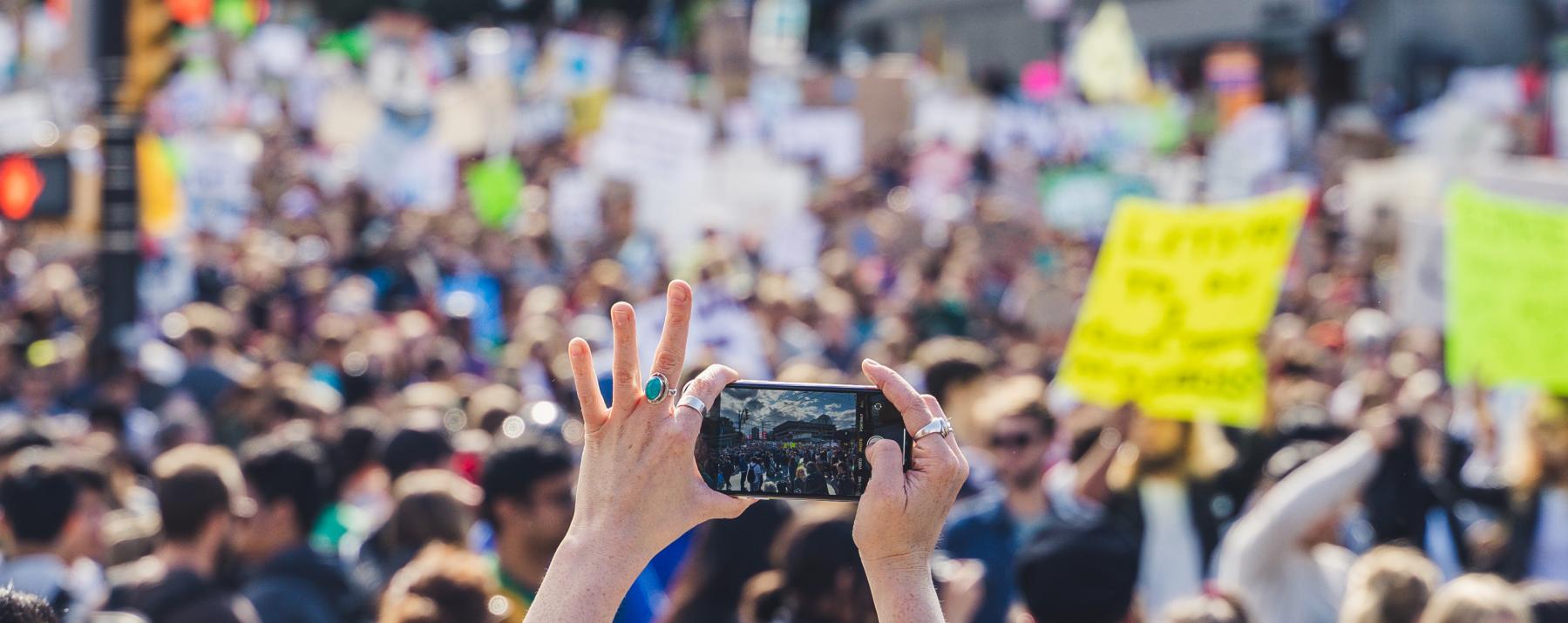
Protester takes a photo of the assembled crowd © Mike Parolini, licensed under Shutterstock
1. Introduction
Across the Middle East and North Africa (MENA), security and counter-terrorism laws, measures and rhetoric are systematically employed to restrict civic space and target human rights defenders, journalists, activists and ordinary citizens for peacefully defending human rights or expressing critical views on state policies and authorities. While the adoption of such frameworks accelerated after 9/11, they became especially embedded and stringent following the uprisings of 2011, which saw waves of peaceful protests demanding political reform and the respect of human rights. State authorities across the region responded by cracking down on the civic space the uprisings had sought to open, notably by expanding and instrumentalising their counter-terrorism and national security frameworks as tools of repression to criminalise peaceful dissent.
A prominent dimension of this repression is the systematic targeting of online expression. As social media became a central tool for the exercise of free speech, the defence of human rights, and the expression of dissenting and critical views, state authorities moved to criminalise it, deploying vague and overbroad security, terrorism and cybercrime definitions, while granting unchecked powers to state security apparatuses, intelligence agencies and exceptional courts to recast social media posts, private messages, hashtags and online videos as terrorism and security offences. These frameworks have inflicted a heavy human toll: individuals across the region have been prosecuted, tortured, forcibly disappeared and sentenced to years or decades in prison for expression that is protected under international human rights law.
What makes this pattern particularly alarming is not only that individuals are being prosecuted for a social media post, a hashtag, or a private message, but that acts of peaceful expression protected under international human rights law are being deliberately criminalised as terrorism and security offences. Unlike ordinary criminal prosecution, counter-terrorism and national security frameworks trigger a distinct and harsher set of consequences: significantly elevated penalties, in some cases amounting to decades in prison or the death penalty; prosecution before specialised, military or exceptional courts that lack the guarantees of judicial independence and impartiality required under international law; severely restricted or denied access to legal counsel; prolonged incommunicado detention; and broad discretionary powers vested in security and intelligence agencies operating under executive authority with limited judicial oversight. In addition, the terrorism label carries a social and political stigma that can be used to delegitimise and isolate those targeted, and to justify further measures against them and their families.
Against this backdrop, this report focuses on Algeria, Jordan, Saudi Arabia and the United Arab Emirates (UAE), where the deliberate exploitation of counter-terrorism and national security frameworks has become a hallmark of how state authorities crack down on freedom of expression, including — and increasingly — online. The report also covers Palestine, where Israeli authorities’ systematic targeting of Palestinian expression is rooted in a longstanding policy of discrimination against Palestinians, which particularly intensified following October 2023 and in the context of Israel’s genocide in Gaza.
The report unveils how state authorities in the region have constructed and weaponised legal and institutional frameworks specifically designed to criminalise peaceful dissent under the guise of countering terrorism and protecting national security. It examines the counter-terrorism, cybercrime and security-related legislation deployed to this end, identifying a consistent pattern of vague and overbroad definitions of terrorism, false news and security offences that fail to comply with the principle of legality under international human rights law and grant authorities sweeping discretionary powers to prosecute protected expression. It further exposes the institutional architecture enforcing these abusive frameworks: security apparatuses, exceptional and military courts, and prosecution services operating outside the guarantees of judicial independence and impartiality, designed to leave individuals with fewer legal protections and to enable repression under the pretence of legality. Drawing on the standards and findings of United Nations (UN) human rights experts, including Special Procedures mandate holders and Treaty Bodies, as well as civil society documentation and testimonies of victims of human rights violations, the report assesses these frameworks within the scope of international human rights law.
To illustrate how this operates in practice, the report documents one emblematic case from each context: Ali Mammeri, a trade union leader and Hirak activist in Algeria, sentenced to 15 years in prison, later reduced to 10 on appeal, for social media posts, private messages and online interactions prosecuted as terrorism; Kamil al-Zoubi, a Jordanian political activist arrested numerous times and subjected to repeated prosecutions under the Cybercrime Law and Penal Code for social media posts critical of the authorities; Manahel al-Otaibi, a fitness instructor and blogger vocal about women’s rights in Saudi Arabia, sentenced to 11 years in prison under counter-terrorism legislation for her peaceful social media activity; Abdulrahman al-Qaradawi, an Egyptian-Turkish poet and activist, extradited from Lebanon and subjected to enforced disappearance and arbitrary detention in the UAE following a video posted on social media criticising governments from the region; and Yasmeen Qaddoura, one of hundreds of Palestinians targeted by Israeli authorities for online expression, arrested and prosecuted for a WhatsApp status.
2. International legal framework
2.1 The right to freedom of expression under international and regional law
The right to freedom of expression is protected under article 19 of the International Covenant on Civil and Political Rights (ICCPR), to which Algeria, Israel and Jordan are parties. Article 19(2) provides that everyone shall have the right to freedom of expression, encompassing the freedom to seek, receive and impart information and ideas of all kinds, regardless of frontiers and through any media. The UN Human Rights Committee has confirmed, in its General Comment No. 34 on Article 19, that this right extends to political discourse, commentary on public affairs, journalism, and “electronic and internet-based modes of expression”. The Committee has underlined that freedom of expression is “a necessary condition for the realisation of the principles of transparency and accountability that are, in turn, essential for the promotion and protection of human rights.”
Article 20 of the ICCPR sets out the only mandatory restriction on expression: States are required to prohibit propaganda for war and advocacy of national, racial or religious hatred constituting incitement to discrimination, hostility or violence. Outside this narrow category, restrictions on expression must comply with the strict three-part test set out in article 19(3), which constitutes the applicable standard under international human rights law for assessing the permissibility of any restriction on freedom of expression.
The Universal Declaration of Human Rights (UDHR) similarly protects the right to freedom of opinion and expression under its article 19, including the freedom to hold opinions without interference and to seek, receive and impart information and ideas through any media. The UDHR is widely recognised as reflecting customary international law, rendering its protections applicable to all states irrespective of the treaties they have ratified.
At the regional level, the Arab Charter on Human Rights (ACHR), adopted by the League of Arab States in 2004 and in force since 2008, protects the right to information and freedom of opinion and expression under its article 32. Algeria, Jordan, Saudi Arabia and the UAE are all States parties to the Arab Charter. Under article 32(1), the Arab Charter guarantees freedom of opinion and the right to information as rights protected through “all means of expression”. Article 32(2) provides that such rights and freedoms may only be restricted by law, and only to the extent necessary for the respect of the rights or reputations of others, the protection of national security, public order, public health, or public morals.
2.2 Permissible restrictions on freedom of expression: The three-part test
Under article 19(3) of the ICCPR, any restriction on freedom of expression must satisfy three cumulative conditions, all of which must be met for the restriction to be lawful. Failure to meet any one of them renders the restriction a violation of international law.
The first condition is legality: the restriction must be provided by law. This requires not merely that a legal provision exist, but that the law be formulated with sufficient precision and clarity to enable individuals to regulate their conduct accordingly. General Comment No. 34 makes clear that vague or overbroad laws fail to meet this requirement, because they do not allow individuals to foresee with reasonable certainty what expression may expose them to legal liability.
The second condition is legitimate aim: the restriction must serve one of the purposes exhaustively listed in article 19(3), namely the respect of the rights or reputations of others, or the protection of national security, public order, public health, or public morals. The enumeration is closed: restrictions cannot be justified by purposes falling outside this list, however compelling the government’s rationale may be. Importantly, the mere invocation of one of these purposes, including national security, is not sufficient. General Comment No. 34 specifies that “national security” refers specifically to the protection of a State’s political independence or territorial integrity, and that a State invoking it must “demonstrate in specific and individualised fashion the precise nature of the threat and the necessity and proportionality of the specific action taken, in particular by establishing a direct and immediate connection between the expression and the threat.” The Human Rights Committee explicitly warns that it is incompatible with article 19(3) to invoke national security or related provisions to prosecute journalists, researchers, human rights defenders or others for disseminating information of legitimate public interest.
The third condition is necessity and proportionality: the restriction must be necessary to achieve the legitimate aim and must not be overbroad. General Comment No. 34 clearly states that a restriction only meets the necessity test if the legitimate aim cannot be achieved by other means that do not restrict freedom of expression.
2.3 Counter-terrorism and security frameworks and freedom of expression
The UN Security Council, whose resolutions are binding on all UN Member States, has affirmed, notably in Resolution 1624 (2005) and subsequent resolutions including Resolution 2178 (2014) and Resolution 2617 (2021), that States are required to ensure that all measures taken to counter terrorism comply with their obligations under international human rights law, international refugee law, and international humanitarian law.
The Special Rapporteur on the promotion and protection of human rights and fundamental freedoms while countering terrorism has developed, across successive mandate holders, a model definition of terrorism intended to guide States in drafting legislation that is human rights-compliant. First elaborated in 2010, this model definition was updated in 2026 to limit the concept of terrorism to serious criminal acts that intentionally cause death, serious bodily injury or hostage-taking, committed with the specific purpose of provoking a state of terror in the public or a group of persons, or of unduly compelling a government or international organisation to act or refrain from acting, and intended to advance a political or ideological purpose. The model definition explicitly excludes from its scope “acts of advocacy, protest, dissent or industrial action that do not intentionally cause death or serious bodily injury.” In the same report, the Special Rapporteur reaffirms that vague and overbroad definitions are among the most common human rights violations in counter-terrorism contexts, noting that they are prone to both unintended consequences and deliberate abuse and have often led to violations of freedom of expression and fallen heavily on civil society, including human rights defenders, journalists and political opponents.
A recurring overbroad and vague feature of counter-terrorism and security-related legal frameworks threatening freedom of expression, online and offline, is the criminalisation of “false news,” “false information” or “rumours”. The 2017 Joint Declaration on Freedom of Expression and “Fake News,” Disinformation and Propaganda, issued jointly by the UN Special Rapporteur on freedom of opinion and expression and regional freedom of expression mechanisms, establishes that “general prohibitions on the dissemination of information based on vague and ambiguous ideas, including ‘false news’ or ‘non-objective information’, are incompatible with international standards for restrictions on freedom of expression” and should be abolished.
The Office of the High Commissioner for Human Rights (OHCHR) has reinforced these standards in its 2025 Guidance Note on Defining Terrorism in National Criminal Legislation and its 2024 Toolkit on Strengthening Human Rights in Counter-Terrorism Strategy and Policy, warning against vague purpose elements such as “undermining social order” or “harming national unity” that extend terrorism offences to protected conduct, cautioning that laws criminalising “encouragement,” “glorification,” “apology” or “justification” of terrorism risk undue interference with freedom of expression.
The 2008 Joint Declaration on Defamation of Religions, and Anti-Terrorism and Anti-Extremism Legislation, issued jointly by the UN Special Rapporteur on freedom of opinion and expression and regional freedom of expression mechanisms, provides that the definition of terrorism, at least as it applies in the context of restrictions on freedom of expression, should be restricted to violent crimes, and that vague notions such as providing “communications support” to terrorism or extremism, the “glorification or promotion” of terrorism or extremism, and the “mere repetition of statements by terrorists” should not be criminalised.
The Human Rights Committee also specifically cautions that laws criminalising offences such as “encouragement of terrorism,” “praising,” “glorifying,” or “justifying” terrorism must be “clearly defined to ensure that they do not lead to unnecessary or disproportionate interference with freedom of expression.”
3. Algeria
In Algeria, the authorities have systematically exploited vaguely worded counter-terrorism and national security legislation to prosecute individuals for peaceful dissent, targeting protesters, independent journalists, human rights defenders and social media users. This pattern became particularly prominent following the Hirak protest movement, which began in February 2019 and saw mass demonstrations across Algeria demanding political reform. Rather than engaging with these demands, the authorities responded with a sweeping crackdown, instrumentalising counter-terrorism legislation to silence those speaking out. According to notable human rights defender and former prisoner of conscience Zakaria Hannache, the authorities imprisoned over 1,400 people for politically-related motives since the Hirak.
Unlike in several other countries examined in this report, Algeria does not maintain a distinct exceptional jurisdiction or specialised court for counter-terrorism and security-related offences, with such charges being prosecuted before ordinary criminal courts. The absence of such a specialised framework does not, however, shield individuals from the harsh consequences that flow from being prosecuted under counter-terrorism provisions, which carry penalties of exceptional severity, systematically elevated beyond those applicable under ordinary criminal law, with offences such as “apology for terrorism” carrying up to 10 years in prison and other terrorism-related offences punishable by life imprisonment or the death penalty. In practice, these provisions have been wielded against human rights defenders, journalists, trade unionists and peaceful activists solely for the exercise of their right to freedom of expression online, including through a Facebook post, a private message, or a social media interaction.
The legal framework enabling this repression rests primarily on three instruments: the Penal Code, whose definition of terrorism was significantly broadened through successive amendments in 2021 and 2024; the 2023 Law on Information; and the 2021 Ordinance on the protection of administrative information and documents. Together, these texts have created an environment in which a social media post criticising governmental policies can be prosecuted as a terrorist act carrying up to 10 years’ imprisonment, publishing information classified as secret or confidential by the authorities can result in between five and 15 years in prison, and the mere sharing or “liking” of content online can constitute an offence of “apology for terrorism.”
3.1 Legal and institutional framework
3.1.1 Penal Code
Algeria’s Penal Code has become the primary instrument through which the authorities criminalise peaceful online expression under the guise of counter-terrorism. At its core is article 87 bis, a provision defining terrorism in terms so broad and imprecise that it has been applied to social media posts, private messages and online interactions falling under the right to freedom of expression, targeting human rights defenders, journalists, trade unionists and peaceful activists.
Article 87 bis of the Penal Code defines acts of “terrorism or sabotage” as “any act targeting the security of the State, national unity, stability, and normal functioning of institutions” committed with the intent to, among others, “attack the symbols of the Nation and the Republic”, “obstruct the functioning of public institutions”, “hinder the enforcement of laws and regulations”, “work or incite, by any means whatsoever, to gain power or change the system of governance by unconstitutional means”, or “undermine the integrity of the national territory or incite others to do so, by any means whatsoever.” In practice, article 87 bis was used to charge Mohamed Tadjadit, widely known as “the poet of the Hirak” and repeatedly prosecuted since 2019 for his poetry and activism, with “apology for terrorism” on the basis of political poems he recited in videos posted on Facebook and TikTok and private online conversations.
Article 87 bis 4 provides for between five and 10 years in prison for “anyone who makes apology for, encourages or finances” terrorist or sabotage acts “by any means whatsoever.” Human rights defender Mohad Gasmi was sentenced to five years in prison under this provision for a Facebook post critical of the authorities. Article 87 bis 5 punishes with between five and 10 years in prison “anyone who knowingly reproduces or disseminates documents, printed matter or information” deemed as “apology” for terrorist or sabotage acts. Article 87 bis 12 criminalises the use of information and communications technologies to recruit individuals on behalf of a terrorist organisation, or to support its acts or activities or disseminate its ideas, whether directly or indirectly, punishable by imprisonment of five to 10 years. Human rights lawyer Sofiane Ouali was arrested in 2024 and charged under articles 87 bis 4 and 87 bis 12 for organising a sit-in outside a court in solidarity with one of his detained clients.
Algerian authorities have prosecuted individuals on the basis of their alleged association with the political opposition movement Rachad and the Movement for the Self-Determination of Kabylie (MAK), designated as “terrorist organisations” by the High Security Council in May 2021. UN Special Procedures warned that this listing process was incompatible with the presumption of innocence and lacked the procedural safeguards required under international human rights law.
The Penal Code further imposes two layers of severity on those prosecuted under its counter-terrorism provisions. First, article 87 bis 1 establishes a penalty scheme applicable to article 87 bis, systematically elevating penalties beyond those that would otherwise apply: where ordinary criminal law provides for life imprisonment, the death penalty applies; where it provides for 10 to 20 years, life imprisonment applies; and where it provides for five to 10 years, 10 to 20 years applies. Second, the 2024 amendments to the Penal Code introduced a mandatory non-parole period under article 87 bis 9, prohibiting anyone convicted of a counter-terrorism offence from benefiting from any sentence reduction or early release measure, including sentence suspension, work release, day release, semi-liberty or conditional liberation, for a duration equal to half the sentence pronounced, or 20 years in the case of a life sentence.
In addition to the article 87 bis framework, two further Penal Code provisions have been deployed to criminalise online expression. Article 96 of the Penal Code carries a sentence of one to five years in prison for “anyone who distributes, offers for sale, displays in public or possesses for the purpose of distribution, sale or display, for propaganda purposes, leaflets, bulletins, flyers, videos or audio recordings likely to harm the national interest”, with the penalty doubled for content “of foreign origin or inspiration.” Article 196 bis provides for between one and three years in prison for “anyone who deliberately disseminates or propagates, by any means, false or defamatory information or news to the public that is likely to undermine public security or public order.”
Algeria’s counter-terrorism framework has attracted sustained and growing criticism from UN human rights bodies and experts. In 2018, the Human Rights Committee found that article 87 bis defined terrorism “in overly broad and vague terms that would allow for the prosecution of actions that might constitute exercise of the freedom of expression,” and called on Algeria to amend it so that it “clearly defines what constitutes an act of terrorism.” Rather than addressing these concerns, Algerian authorities expanded the scope of article 87 bis further through the 2021 and 2024 amendments. UN experts warned that these successive expansions could “negatively impact freedoms of expression, association, and peaceful assembly”, and that the imprecision of the provision “opens the door to excessive and arbitrary criminalisation, which in some cases may amount to judicial harassment.” Following country visits to Algeria in 2023, the Special Rapporteur on freedom of peaceful assembly and association stated that “in almost every conversation he had with civil society representatives, concerns were raised about article 87 bis”, describing it as “inconsistent with the principle of legal certainty” and ultimately recommending its repeal. The Special Rapporteur on human rights defenders similarly observed that “the definition of terrorism in article 87 bis is so broad and vague that it makes it possible for human rights defenders to be arrested on a large scale.” UN experts raised particular concern about the related provisions, noting the “broad, imprecise and unpredictable scope” of the concepts of “apology” and “encouraging” terrorism under articles 87 bis 4 and 5, the absence of exclusions for legitimate purposes under article 87 bis 12, and warning that articles 96 and 196 bis “open the door to legal proceedings against journalists, peaceful activists or anyone sharing critical content that is subsequently deemed 'false' by the authorities, thereby limiting public debate.”
3.1.2 Law on Information
The Algerian 2023 Law on Information, which replaced the 2012 version, adds an additional layer of restriction on freedom of expression, in particular for journalists and media outlets. Its vaguely worded provisions which include prohibitions on content deemed to “promote terrorism” or undermine “national unity”, mirror the overbroad terminology of the Penal Code and grant authorities broad discretionary powers over journalistic activity.
Article 3 of the Law on Information provides that “media activities are exercised freely in compliance with the provisions of the Constitution, this organic law, and applicable legislation and regulations”, with respect for “national sovereignty,” “national unity,” “territorial integrity,” and “the elements and symbols of the State.” Article 35 provides that in the exercise of their journalistic activity, journalists “must in particular refrain” from “undermining national memory, or the symbols of the national liberation war,” or “directly or indirectly” promoting “terrorism” or “intolerance.”
The UN Special Rapporteur on human rights defenders raised concerns about the law’s “vague concepts, the interpretation of which is left to the discretion of the competent authorities”, noting that this “allows unjustified restrictions on freedom of opinion and expression and, in the worst case, the criminalisation of the actions of independent journalists, bloggers and media outlets.” The Special Rapporteur further reported that following the law’s enactment, “journalists and bloggers no longer knew where the “red line” was and could be attacked or treated as criminals for writing on almost any subject.”
3.1.3 Ordinance on the protection of administrative information and documents
Algeria’s 2021 Ordinance on the protection of administrative information and documents further extends the legal framework through which online expression can be criminalised under the guise of protecting national security, including sweeping classification powers, severe criminal penalties for the online publication of classified information, and broad surveillance authorities enabling the monitoring of individuals’ online activity and private communications.
The Ordinance defines “information” broadly in its article 3(4) as “any event or news, whatever its source, a document, photo, sound, visual or audiovisual recording, a conversation or telephone call, whose disclosure harms the authorities concerned.” It further classifies in its article 6 information held by state institutions, public administrations and public enterprises into four categories of sensitivity defined by reference to national security interests:
- “Top secret”: covering documents whose disclosure would “undermine internal and external national security”;
- “Secret”: covering documents whose disclosure would “cause serious harm to the interests of the State”;
- “Confidential”: covering documents whose disclosure would “cause certain harm to the interests of the Government, ministries, administrations or a public body”; and
- “Restricted distribution”: covering documents whose disclosure would “harm the interests of the State.”
Articles 28 to 48 impose criminal penalties for the disclosure, publication or dissemination of classified information, ranging from three months to 15 years in prison depending on the classification level and circumstances. Of particular concern for online expression is article 38, which punishes with between five and 10 years in prison anyone who “creates, manages or supervises a website, electronic account or computer programme” to publish classified information, as well as anyone who publishes classified information on an electronic network; and article 39, which punishes with between 10 and 15 years in prisont anyone who “knowingly publishes or disseminates by electronic communications or computer system a classified information or document with the aim of undermining public order and public tranquillity.” In practice, these provisions were used to charge trade unionist Ali Mammeri, whose case is detailed in this report, on the basis of private messages exchanged with trade union colleagues and family members, and online interactions with political opponents, which the authorities characterised as “dissemination of classified information”.
The Ordinance further grants broad surveillance powers: article 22 requires service providers to assist judicial inquiry authorities in the real-time collection and recording of communications content data, while article 25 authorises judicial police officers to place technical tools on electronic networks to receive denunciations of offences under the Ordinance. These provisions enable the authorities to monitor individuals’ private online communications, providing the evidentiary basis for prosecutions under both the Ordinance and the broader counter-terrorism framework.
The classification categories established by the Ordinance, defined by reference to vague and expansive notions such as “the interests of the State” and “national security”, are incompatible with international human rights standards, including the principle of legal certainty. They do not provide for exceptions or limit the government’s broad and discretionary power to classify information, and pave the way for authorities to disproportionately restrict the right to information and target political dissidents and journalists under the pretext of national security. UN human rights experts further raised concern about the Ordinance’s surveillance provisions, flagging their use to justify criminal charges against individuals for their online communications and social media publications, in violation of their right to freedom of expression.
3.2 Ali Mammeri: Trade union activism and online dissent prosecuted as terrorism
Ali Mammeri is a civil servant, leader of the National Union of Civil Servants in the Field of Culture and Arts (SNFC) and member of the Trade Union Confederation of Productive Forces (COSYFOP). He played a role in launching a unionisation campaign in the cultural sector, which had no trade union representation, created a committee to protect workers’ rights, and was elected as president of the SNFC-COSYFOP Executive Committee in March 2025. He was also an activist in the Hirak protest movement.
On 19 March 2025, plainclothes agents arrested Ali Mammeri at his workplace in Oum El Bouaghi in Northeastern Algeria, without a warrant or information on the reasons for his arrest, and held him incommunicado until 23 March 2025. The next day, Mammeri contacted his mother, confirming that he was being held at the headquarters of the Security Department of the Wilaya of Constantine.
During a visit by his counsel, Mammeri stated that he was subjected to physical and psychological torture. He explained that he was beaten during the first two days in police custody, stripped naked and insulted. The alleged purpose was to force him to sign a confession stating that he belonged to a terrorist organisation.
According to Mammeri’s lawyer, the Constantine Directorate-General for Internal Security’s police report contained findings such as screenshots, text messages and online publications.
At the end of his police custody on 27 March 2025, he was brought before the Prosecutor at the Oum El Bouaghi Court, who decided to refer the case to the examining magistrate, requesting to open an investigation on the basis of articles 87 bis 1, 4 and 5 of the Penal Code, as well as articles 34 and 39 of the Ordinance on the protection of administrative information and documents.
He was charged with “having intentionally, by means of electronic communications or a computer system, disseminated or published information or a document with the aim of undermining public order and public tranquillity”, “advocating terrorist and sabotage acts, encouraging and financing them by any means whatsoever” and “deliberately reproducing and publishing documents, printed matter or recordings praising terrorist and subversive acts.”
The judicial police report on Mammeri’s case includes exchanges between him and several members of the COSYFOP, in particular with COSYFOP president Raouf Mellal, who reported persistent judicial and police repression himself and obtained refugee status in a third country. The exchanges between Mammeri and Mellal were interpreted by the authorities as “harming the national interest,” with the COSYFOP being labelled a “subversive organisation” and its members being assimilated with elements “hostile to the unity of the country and public order.” The police report mentions that Mammeri had exchanges with “subversive individuals” with a view to creating a trade union committee for the defence of human rights, with the aim of overthrowing the government through “unconstitutional means.”
The judicial police report also includes private, family-related communications between Mammeri and Hicham Aboud, a journalist and member of his family included in the 2022 national list of terrorist persons and entities and granted refugee status in France. Also appearing in the police report was an exchange between Mammeri and prominent Algerian blogger and dissident Amir Boukhors, known as ‘Amir DZ’, included in the same 2022 terrorism list and granted refugee status in France. In this exchange, Mammeri sent Boukhors a video in which he spoke about the difficult situation for workers and the challenges facing the cultural sector in Algeria. Boukhors never responded to Mammeri’s messages, and they were never posted on social media.
A number of Mammeri’s Facebook posts, online statements and interactions with political opponents’ pages were also presented in the judicial police report, including simple “likes”, comments or shares. The authorities cited his posts, shares and interactions on social media to justify charges of “advocating terrorism.”
On 29 October 2025, the Oum El Bouaghi Criminal Court sentenced Mammeri to 15 years’ imprisonment on the basis of articles 87 bis 4 and 12, 96, 100 and 146 of the Algerian Penal Code. On 1 February 2026, the Oum El Bouaghi Criminal Court of Appeal upheld his conviction, reducing his sentence to 10 years in prison.
In a communication sent to the Algerian authorities, UN human rights experts expressed concern about the case against Mammeri, noting that the application of the offence of advocating terrorism for opinions he expressed in a manner consistent with international law constituted a violation of his right to freedom of expression. The experts highlighted that the proceedings against Mammeri “appear to be based on online publications expressing legitimate disagreements with government management” and “exchanges with members of a movement that, at the time of the events, was not designated as ‘terrorist’,” stating that such acts are protected under international human rights law. The experts warned that Mammeri’s case risked “creating a climate of intimidation and self-censorship that discourages public debate, restricts civic space and hinders the expression of dissenting or critical opinions, contrary to Algeria's international obligations.”
4. Jordan
Jordanian authorities have long criminalised speech deemed critical of the King, government officials and state policies through broadly worded provisions of the Penal Code, creating a climate of repression and self-censorship for journalists, activists and ordinary citizens. This pattern escalated significantly following the Arab Spring, which prompted a tightening of restrictions on civic space, and particularly intensified after October 2023, when the authorities expanded their targeting of pro-Palestinian activists and critics of Jordan’s ties with Israel online.
Jordan maintains a distinct exceptional institutional architecture specifically designed to prosecute security-related and counter-terrorism offences. It encompasses the General Intelligence Directorate and the Preventive Security branch of the Public Security Directorate which carry out arrests and conduct interrogations, and the State Security Court, a special court that tries civilians outside the ordinary justice system. Together, these bodies operate without the guarantees of oversight, due process and impartiality required under international human rights law, affording individuals prosecuted under Jordan’s counter-terrorism or cybercrime framework significantly fewer procedural protections than ordinary criminal proceedings.
The legal framework enabling this repression rests primarily on three instruments: the 2014 Counter-Terrorism Law, which broadened the definition of terrorism to encompass acts including online expression; the 2023 Cybercrime Law, which criminalises a broad range of online expression deemed harmful to national security and public order; and the Penal Code, which criminalises speech deemed critical of the King or the political regime. Together, these texts have created an environment in which peaceful online dissent and expression critical of the government can be prosecuted as a cybercrime punishable by up to three years in prison or as a terrorist offence punishable by up to 20 years in prison.
4.1 Legal and institutional framework
4.1.1 Counter-Terrorism Law
Jordan’s counter-terrorism framework was significantly expanded by 2014 amendments to the 2006 Anti-Terrorism Act No. 55 (hereinafter: “Counter-Terrorism Law”), introducing provisions that explicitly criminalise the use of information systems and online communications in connection with broadly defined terrorist offences.
Jordan’s Counter-Terrorism Law defines a terrorist act under its article 2 as:
“any intentional act, threat thereof, or omission thereof, whatever its motives, purposes or means, committed in the execution of an individual or collective criminal plan that would endanger the safety and security of society, cause sedition, disrupt public order, spread fear among people or terrorise them, endanger their lives, damage the environment, public or private property, international facilities or diplomatic missions, or occupy or seize any of them, endanger national or economic resources, compel a legitimate authority or an international or regional organisation to perform or refrain from any act, or disrupt the application of the constitution, laws or regulations.”
Article 3 sets out a list of acts deemed to constitute prohibited terrorist acts, including provisions relevant to the criminalisation of online expression. Article 3(b) prohibits carrying out acts liable to expose the Kingdom to the risk of hostile acts, to disrupt its relations with a foreign state, or to expose Jordanians to the risk of retaliatory acts against their persons or property. Article 3(e) prohibits using an information system, computer network, or any means of dissemination or communications, or creating a website, to facilitate the commission of terrorist acts, to support a group, organisation or association that carries out terrorist acts, to promote its ideas, or to finance it. Article 7(c) of the Counter-Terrorism Law punishes acts falling under articles 3(b) and 3(e) by temporary imprisonment.
In 2017, the UN Human Rights Committee found that the Counter-Terrorism Law’s broadened definition of terrorism “would allow authorities to detain and prosecute, among others, individuals who exercise their right to freedom of expression and peaceful assembly,” and recommended Jordan review the law “to ensure that its definition of terrorism and terrorist acts is in conformity with the Covenant and international standards.” In 2021, UN Special Procedures mandate holders expressed concern that the Counter-Terrorism Law provides “an overly broad definition of terrorism that encompasses a wide range of acts, the vagueness of which is inconsistent with the principle of legality.”
4.1.2 Cybercrime Law
Jordan’s 2023 Cybercrime Law, which repealed and replaced the 2015 Electronic Crimes Law, has become the primary instrument through which the authorities criminalise online expression, imposing criminal penalties on content deemed harmful to “national security” and “community peace,” and extending criminal liability to the managers of social media accounts, pages, groups and channels for content published on them by others.
Article 15(a) of the Cybercrime Law punishes with imprisonment of not less than three months and not more than one year, and a fine, anyone who “intentionally sends, resends, or publishes data or information through an information network, information technology, information system, website, or social media platforms that includes fake news targeting the national security and community peace, or defames, slanders, or holds in contempt any person.” Article 15(b) specifies that prosecution under article 15(a) may be initiated by the public prosecutor without a complaint from the victim where the content is directed at a government body, official institution, or public administration.
Article 17 punishes with imprisonment of not less than one year and not more than three years, and a fine, anyone who "intentionally uses an information network, information technology, information system, website, or social media platform to stir up sedition or target community peace, incite hatred, call for or justify violence, or insult religions.”
Article 25(a) specifies that responsibility for illegal content under the Cybercrime Law lies with the person who is the actual manager of the website or social media platform, or the actual manager of any public page, group or channel, and that such person is liable for content published on it that violates the law. Article 25(b) provides that this does not apply to government bodies, official institutions or personal accounts, unless the owner of the personal account or the responsible person refused to remove the illegal content upon request by the person harmed or the competent authority.
In practice, these provisions have been used to prosecute journalists and activists for online expression critical of government policies or in solidarity with Palestine. Teacher and activist Sameer Nemrawi was prosecuted on multiple occasions under the Cybercrime Law for social media posts calling for demonstrations in support of Gaza and criticising the King and the General Intelligence Directorate, including a one-year prison sentence in November 2023 and a further detention from October 2024 until August 2025. Activist Fatima Shubeilat was arrested in April 2024 after a video circulated on social media of her participating in a pro-Gaza sit-in near the Israeli embassy in Amman, and charged under articles 15 and 17 of the Cybercrime Law. Activist Kamil al-Zoubi, whose case is detailed in this report, has been repeatedly targeted under the Cybercrime Law for his online political activism and criticism of the authorities, most recently sentenced to two years in prison in January 2026 and an additional two years in February 2026.
Upon the 2023 Cybercrime Law’s adoption, the OHCHR warned that it “unduly restricts and criminalises online activities by individuals and organisations” and that its provisions “target the content of online expression, are open to wide interpretation and fail to comply with international human rights law requirements of legality, legitimate aim, necessity and proportionality for restrictions on the right to freedom of expression.” In 2024, the Committee against Torture expressed concern that the Cybercrime Law may “criminalise legitimate online activities” due to its “vague definitions of offences,” which “could be used to restrict the right to freedom of expression and arbitrarily detain journalists and others,” underlining that “it does not meet the international human rights law requirements for the restriction of an individual liberty of legality, legitimate aim, necessity and proportionality.” UN Special Procedures mandate holders similarly highlighted that article 15 “appears to place increased restrictions on freedom of expression online,” urging Jordan to “revise the Cybercrime Law to bring it in line with international standards”.
4.1.3 Penal Code
Jordan’s Penal Code is frequently invoked alongside the Counter-Terrorism Law and Cybercrime Law to prosecute online expression, most notably through article 149 (1), which falls within the terrorism section of the Penal Code.
Article 149(1) of the Penal Code provides that any person who commits any act liable to undermine the political system of government in the Kingdom or to incite opposition to it, or who commits an individual or collective act with the purpose of changing the economic or social structure of the State or the fundamental conditions of society, shall be punished by temporary imprisonment. Pursuant to article 20(2) of the Penal Code, where no special provision is contained in the law, the minimum sentence for temporary imprisonment is three years and the maximum is 20 years. In practice, this provision has been used to prosecute and sentence political activist and teacher Ayman Sandokah to five years in prison for a Facebook post addressed to the King criticising Jordan's ties with Israel.
In 2017, the UN Human Rights Committee expressed concern about “reports that journalists continue to face prosecution and sanctions” under the Penal Code and the Counter-Terrorism Law “if they express views considered critical, including ‘insults to the King’,” recommending Jordan “review its legislation with a view to ensuring that criminal sanctions are not applied to persons expressing critical views.”
4.1.4 The role of the General Intelligence Directorate, Public Security Directorate, and State Security Court
Jordan's counter-terrorism and cybercrime framework against online expression is enforced through three main bodies: the General Intelligence Directorate (GID), the Preventive Security branch of the Public Security Directorate (PSD), and the State Security Court (SSC). The GID and PSD operate without the oversight required under international human rights law, while the SSC fails to meet the requirements of judicial independence and impartiality.
The GID, whose General Director is appointed directly by the King and reports to the Prime Minister, is tasked with carrying out “intelligence duties and operations to safeguard national security” and “combating terrorism.” In practice, the GID carries out arrests in civilian clothing and operates its own detention facility, although it lacks formal powers of arrest or detention. The PSD, which falls under the authority of the Ministry of Interior, includes a Cybercrime Unit within its Criminal Investigation Department, established in 2008 and responsible for investigating cybercrime offences. Both the GID and the PSD have been central to the crackdown on online expression in Jordan: teacher and activist Sameer Nemrawi was arrested by members of both the GID and the PSD in November 2023 for social media posts calling for demonstrations in support of Gaza; activist Fatima Shubeilat was arrested in April 2024 after a video of her participating in a pro-Gaza sit-in circulated on social media, with the Cybercrime Unit of the PSD initiating a separate case against her after the Public Prosecutor had already agreed to release her on bail; and activist Kamil al-Zoubi was arrested in November 2023 by approximately 20 members of the GID and the PSD following a tweet about military equipment being transported to Israel from Jordan.
The SSC, a special court established under Law No. 17 of 1959 and composed of civilian and/or military judges appointed by the Prime Minister, has jurisdiction over terrorism offences under the Counter-Terrorism Law and the Penal Code, including article 149. As such, individuals charged under article 149 of the Penal Code or the Counter-Terrorism Law for online expression are tried before a special court rather than an ordinary civilian court. This was notably the case for Ayman Sandokah, who was held without bail for months pending trial and denied access to his lawyer before being sentenced to five years in prison by the SSC for a dissenting Facebook post.
The UN Human Rights Committee has called on the Jordanian authorities to abolish the SSC, expressing concern that the court “is neither independent nor impartial,” “consistently tries civilians” and that its “practices violate the right to a fair trial.” The Committee against Torture similarly expressed concern about the “reported lack of independence and impartiality” of the SSC. Special Procedures mandate holders have also expressed concern about “the reported use of military courts to prosecute civilians” for speech-related charges, recalling that “trials of civilians by military or special courts should be exceptional”.
4.2 Kamil al-Zoubi: Peaceful political expression repeatedly prosecuted as cybercrime
Kamil al-Zoubi is a Jordanian political activist who has participated in peaceful protests calling for reforms and accountability for corruption since the beginning of the Arab Spring in late 2010. Since then, he has been arrested approximately 10 times and detained around 14 times, including on at least five instances for his online expression, particularly for posts critical of the authorities and expressing pro-Palestine advocacy.
In December 2014, al-Zoubi was arrested by GID agents in Irbid, after publishing social media posts criticising the expenditures of the royal palaces, financial allocations to King Abdullah II and his entourage, the lack of reforms, and state corruption. He was referred to the State Security Court, where he was charged with “insulting the King” and “undermining the regime”. In January 2015, he was released on bail and placed under a travel ban.
In December 2020, al-Zoubi was interrogated by the Cybercrime Unit of the PSD. He was detained for one day and then released on bail. He was subsequently charged with three counts of defamation by the Prosecutor of the Ramtha Court. Two charges were later dropped.
In October 2021, after al-Zoubi tweeted that the Jordanian Prime Minister’s wife “received money by exploiting her husband’s position”, implying corruption, the Prime Minister filed a defamation lawsuit against him. Al-Zoubi was arrested and charged with “slandering an official body”, “broadcasting fake news”, and “undermining the prestige of the state” on the basis of articles 132 and 191 of the Penal Code. After 25 days, the Prime Minister dropped the charges against him, and al-Zoubi was released. The case attracted a great deal of media attention, leading the prosecutor to ban any publication on the subject.
In August 2022, al-Zoubi shared on Facebook a statement from his lawyer, Firas al-Rousan, describing alleged acts of torture in detention against one of his clients. Consequently, in September 2022, new charges were brought against al-Zoubi and his lawyer, based on several provisions of the Penal Code and the Cybercrime Law, including vilifying an official body and the Parliament Council, broadcasting false news and harming the reputation of the State. In October 2024, after his trial was postponed several times, al-Zoubi was sentenced to six months of imprisonment on charges of defaming an official body, under article 191 of the Penal Code and article 15 of the Cybercrime Law.
In November 2023, al-Zoubi was arrested in Ramtha city by approximately 20 members of the GID and the Preventive Security Branch of the PSD. He was beaten, dragged, and pinned to the ground on the main Ramtha roundabout. He was transferred to the Cybercrime unit of the PSD in Amman, where his phone was confiscated, and he was interrogated about a publication on his X (formerly Twitter) account. The post featured a short video of trucks transporting American equipment to Israel from bases within Jordan, with text demanding that the Jordanian government be held accountable. He was charged under the Cybercrime Law with sharing “false news targeting national security and community peace” and sentenced to three months in prison.While incarcerated, in June 2024, an additional case was launched against al-Zoubi based on 12 social media posts he had published in recent years notably criticising the economic situation and corruption in Jordan, expressing his support for Gaza, criticising Jordan’s support of Israel and the arrests of pro-Palestine activists, and shedding light on the cases of activists detained for their criticism of Jordanian authorities. He was charged under article 15(a) of the Cybercrime Law and assessed a fine.
In January 2026, al-Zoubi was arrested in front of his family and children on New Year’s Eve by security forces, who reportedly raided his home without a warrant. He was sentenced to twoyears in prison by the Amman Magistrates Court for publishing information on social media that “undermines social peace” and for “defaming an official body” under articles 15 and 17 of the Cybercrime Law.
In February 2026, al-Zoubi was sentenced again in a new case by the Amman Magistrates Court to an additional two years in prison under the Cybercrime Law.
The repeated arrests and prosecution of al-Zoubi have drawn attention from UN human rights experts, who raised concerns with the Jordanian authorities in a communication dated December 2024. The experts denounced the use of overly vague and broad provisions in the Penal Code and the Cybercrime law to prosecute al-Zoubi, and assessed that his repeated prosecution was related to the exercise of his fundamental rights, including his right to freedom of expression.
5. Saudi Arabia
Since the accession of Crown Prince Mohammed bin Salman (MBS) to power in 2017, Saudi authorities have carried out a sweeping crackdown on freedom of expression, arresting and prosecuting human rights defenders, journalists, academics and activists for peaceful dissent. The crackdown has extended aggressively online: in 2022 alone, 15 people were documented as having been sentenced to between 10 and 45 years in prison solely for peaceful online activities, and in 2023, the Specialised Criminal Court sentenced a retired teacher to death solely for posts on X and YouTube. The 2018 murder of journalist Jamal Khashoggi inside the Saudi consulate in Istanbul drew international condemnation and exposed the extent to which the authorities were willing to go to silence dissent, including beyond Saudi borders.
Saudi Arabia maintains a distinct exceptional institutional architecture specifically designed to prosecute security and counter-terrorism offences. It encompasses the Specialised Criminal Court, established in 2008 and used since 2011 to prosecute peaceful dissent under terrorism charges outside the ordinary justice system, as well as the State Security Presidency, established in 2017 under the direct authority of the King, which carries out arrests and investigations and oversees several detention facilities. The SSP operates without the oversight required under international human rights law, while the SCC fails to meet the requirements of judicial independence and impartiality, and both deny individuals the due process guarantees to which they are entitled.
The legal framework enabling this repression rests primarily on two instruments: the 2014 Counter-Terrorism Law, which contains a broad and vague definition of terrorism that has been used to prosecute peaceful online expression; and the 2007 Cybercrime Law, which criminalises online content deemed harmful to public order, religious values and public morals. Together, these texts have created an environment in which a tweet or social media post can be prosecuted as a terrorist act carrying up to 20 years in prison, and creating or using a website to facilitate communication with a broadly defined terrorist entity also carries up to 20 years in prison. UN experts have notably warned that “Saudi Arabia’s punishments for online expression include the death penalty or prison sentences of several decades under anti-terrorism laws,” finding these “completely inconsistent with international law and human rights standards.”
5.1 Legal and institutional framework
5.1.1 Counter-Terrorism Law
Saudi Arabia’s counter-terrorism framework grants authorities sweeping powers to criminalise peaceful online expression, with the 2017 Law on Combating Crimes of Terrorism and its Financing (hereinafter: “Counter-Terrorism Law”) replacing the 2014 Counter-Terrorism Law and introducing an even broader and vaguer definition of terrorism not restricted to violent acts, as well as several provisions that criminalise online expression and communication.
Article 1 of the Counter-Terrorism Law defines a “terrorist crime” as:
any act committed, individually or collectively, directly or indirectly, by a perpetrator to disturb public order, destabilise national security or State stability, threaten national unity, suspend the Basic Law of Governance or some of its provisions, cause damage to State facilities or natural or economic resources, attempt to coerce any of its authorities into a particular action or inaction, cause harm or death to any person, when the intention of such act, by its nature or context, is to terrorise people, force a government or an international organisation to commit or refrain from committing a certain act, or threaten to carry out acts that would lead to or instigate any of the aforementioned intentions.
Article 38 imposes up to 20 years’ imprisonment on “any person who provides a terrorist entity, a member thereof, or a terrorist individual” with “any communication means” or “information” for “achieving their objectives.” Article 43 punishes with up to 20 years’ imprisonment “any person who creates, launches, or uses a website or a program on a computer or on an electronic device” to commit any of the crimes contained in the Counter-Terrorism Law, or to “facilitate the communication with the leader or a member of any terrorist entity to promote his ideologies or finance his activities.” Article 44 punishes with up to five years’ imprisonment “any person who, by any means, broadcasts or publishes news, statements, false or malicious rumours, or the like for committing a terrorist crime.”
In practice, PhD student and women’s rights activist Salma al-Shehab was arrested in January 2021 by agents of the State Security Presidency and charged under the Counter-Terrorism Law and the Cybercrime Law for tweets supporting women’s rights and political prisoners, receiving a sentence that was ultimately increased to 34 years before being reduced to 27 years on retrial. She was released in February 2025 after serving her full sentence. Nourah al-Qahtani was arrested in July 2021 by the State Security Presidency and charged under the Counter-Terrorism Law for tweets advocating for human rights and calling for the release of political detainees, and was sentenced to 35 years in prison followed by a 35-year travel ban. Manahel al-Otaibi, whose case is examined in detail in this report, was similarly prosecuted under the Counter-Terrorism Law for her social media activity.
Already in 2016, the Committee against Torture had expressed concern that the Counter-Terrorism Law “contains an extremely broad definition of terrorism that would enable the criminalisation of acts of peaceful expression considered as endangering ‘national unity’ or undermining ‘the reputation or position of the State’.” In 2020, UN Special Procedures mandate holders also highlighted that the definition of a “terrorist” crime “does not restrict the acts it criminalises to violent acts,” incorporating a range of ambiguous terms which “raise concerns in regard to the possibility of their arbitrary application due to their lack of legal specificity,” and warning that “the broad character of these phrases could entail that a range of speech and association activities protected under international human rights law is characterised domestically as ‘terrorism’,” and that such a characterisation risks “the conflation of domestic protest, dissent, or peaceful defence of human rights with terrorism.”
In their 2020 communication, UN human rights experts further expressed concern about article 43, warning that it could “allow the authorities to further control media coverage and public discussion on questions deemed to be related to terrorism,” and would “disproportionately affect private individuals, civil society, journalists, human rights defenders, and other actors.” On article 44, they concluded that “general prohibitions on the dissemination of false information would be too vague to be compatible with the requirement of legality” and that, because “the definition of terrorism itself is vague, this does not delimit the provision in a way which would comply with the requirement of legal clarity.”
5.1.2 Cybercrime Law
Saudi Arabia’s 2007 Anti-Cyber Crime Law (hereinafter: “Cybercrime Law”) contains several problematic provisions criminalising online expression, imposing criminal penalties on content deemed harmful to public order, religious values and public morals, and on the use of websites in connection with broadly defined terrorism offences.
Article 6 (1) of the Cybercrime Law imposes up to five years’ imprisonment on any person who commits the cybercrime of “production, preparation, transmission, or storage of material impinging on public order, religious values, public morals, and privacy, through the information network or computers.” Article 7 (1) provides for up to 10 years’ imprisonment for “the construction or publicising of a website on the information network or on a computer for terrorist organisations to facilitate communication with leaders or members of such organisations, finance them, promote their ideologies, publicise methods of making incendiary devices or explosives, or any other means used in terrorist activities.”
In practice, cartoonist and teacher Mohammed al-Ghamdi was arrested in February 2018 by the State Security Presidency, tried before the Specialised Criminal Court, and charged under article 6 (1) of the Cybercrime Law for online artwork and expression criticising government policies, with his sentence reportedly increased to 23 years following secret proceedings in 2024. The Cybercrime Law was also invoked at the appeal stage of the prosecutions of Salma al-Shehab and Nourah al-Qahtani, both sentenced to decades in prison for their peaceful social media activity.
UN Special Procedures mandate holders have expressed concern that the Cybercrime Law, and specifically its article 6, has enabled a “wider crackdown on human rights defenders and social media users, who have been targeted via state vigilance of their social media accounts,” and has been applied to “stifle feminist or political dialogue online,” in “direct violation of the right to freedom of opinion and expression.” In 2024, the UN Committee on the Elimination of Discrimination Against Women denounced Saudi Arabia’s reliance on the Counter-Terrorism Law and the Cybercrime Law “to target human rights defenders and activists, leading to intimidation, hate speech, threats, harassment, arrest, detention and travel bans on women human rights defenders and activists.” The UN Committee on the Elimination of Racial Discrimination similarly expressed concern about “long prison sentences and the death penalty imposed on human rights defenders, activists, lawyers and journalists, based on the overly broad and vague provisions of the Counter-Terrorism Law and the Anti-Cybercrime Law”.
5.1.3 The role of the State Security Presidency, Public Prosecution Office and Specialised Criminal Court
Saudi Arabia’s counter-terrorism and cybercrime framework against online expression is mainly enforced through three bodies operating under the direct authority of the King: the State Security Presidency (SSP), the Public Prosecution Office (PPO), and the Specialised Criminal Court (SCC). The SSP and PPO operate without the oversight required under international human rights law, while the SCC fails to meet the requirements of judicial independence and impartiality.
The SSP, established in July 2017 and reporting directly to the Prime Minister, centralised all state security functions previously held by the Ministry of Interior under a single command, and functions as the primary enforcement arm of the crackdown on dissent, carrying out arrests, investigations and interrogations. The PPO, established in June 2017 and brought under the direct control of the King, with its founding decree providing that it is “directly linked to the King” and that “no one may interfere with its work,” is tasked with investigating acts criminalised under the Counter-Terrorism Law, issuing arrest and subpoena warrants, and referring individuals to the SCC. The SCC, established in 2008 to try terrorism cases, has increasingly been used to prosecute peaceful dissent under counter-terrorism charges.
In practice, these three bodies have acted in concert to prosecute individuals for peaceful online expression: Salma al-Shehab was arrested by the SSP and tried before the SCC, where she was sentenced to 27 years’ imprisonment for tweets; Mohammed al-Ghamdi was arrested by SSP officers, held incommunicado for over 50 days and denied access to legal counsel, before being tried before the SCC for online artwork, with his sentence reportedly increased to 23 years following secret proceedings in 2024.
Furthermore, the Commission for the Promotion of Virtue and the Prevention of Vice, also known as the religious police, while stripped of its powers to pursue, question, arrest or detain individuals in 2016, continues in practice to monitor online behaviour and social media activity, compile reports on individuals, and submit those reports to the police and prosecuting authorities as evidence in criminal proceedings, as illustrated by its role in the case of Manahel al-Otaibi, examined in detail in this report.
In a 2020 communication, UN Special Procedures mandate holders noted that “as a court of exception,” the SCC “is not composed of independent judges but of a panel appointed by the Ministry of the Interior,” and highlighted that the SCC “has reportedly been systematically used to quash criticism and opposition to the government and royal family.” The UN Working Group on Arbitrary Detention, which, in 2023, found the detentions of both Salma al-Shehab and Nourah al-Qahtani to be arbitrary, concluded that their prosecutions before the SCC directly resulted from the peaceful exercise of their right to freedom of expression and were marked by serious violations of fair trial guarantees, including restrictions on access to legal counsel and closed proceedings resulting in disproportionate sentences. Prior to this, in 2016, the Committee against Torture expressed concern that judges of the SCC “have repeatedly refused to act on claims made by defendants facing terrorism charges that they were subjected to torture or ill-treatment during interrogations for the purpose of compelling a confession.”
5.2 Manahel al-Otaibi: Women’s rights advocacy prosecuted as terrorism
Manahel al-Otaibi is a Saudi fitness instructor and blogger who has been vocal about female empowerment on her social media platforms. She had a large following on Snapchat, Twitter (now X), and Instagram, where she shared fitness videos as well as peaceful posts advocating for liberal dress codes for women, LGBTQ+ rights and the abolition of male guardianship. Around 2020, she used hashtags that translate to #societyisready and #abolishguardianship to call for reform of the male guardianship system in Saudi Arabia and was vocal about other violations of the fundamental rights of women within the Kingdom.
In November 2022, al-Otaibi was summoned for interrogation at the al-Sahafa police station in Riyadh because of her social media engagement. She was asked about her Twitter activity, mainly about the hashtags she used, and was informed that they were “against the system”. Following the interrogation, she was transferred to the al-Malaz prison in Riyadh, where she was placed in detention.
On 18 January 2023, al-Otaibi had her first hearing at the Criminal Court of Riyadh, where she was charged with “production, preparation, transmission, or storage of material impinging on public order, religious values, public morals and privacy, through the information network of computers” under article 6(1) of the Cybercrime Law. For this charge, she faced up to five years’ imprisonment. Due to the size of her online following and perceived influence, the Public Prosecutor also ordered the closure of her social media accounts, in accordance with article 13 of the Cybercrime Law.
During the trial, the judge examined the charges and considered several alleged facts. Among them, it was alleged that al-Otaibi had admitted to sharing a video of herself walking in the streets of Riyadh without wearing an abaya, which she had posted on Snapchat. In this regard, al-Otaibi stated that she never publicly posted this video, having only sent it privately through Snapchat to her closest friends. She also stated that she had never told the investigators otherwise and therefore refuted the statement that she allegedly admitted to that claim during her interrogation. She suggested that perhaps one of her friends had posted the clip on a public account without her knowledge.
Additionally, it was alleged that she used her Twitter and Snapchat accounts to combat Saudi laws that apply to women. On her Twitter account, she reportedly used the hashtag #endmaleguardianship, which was alleged to “lead to rebellion against state policies, the Saudi courts, and religious values”. According to a report of the Director of the Riyadh Regional Police, al-Otaibi allegedly opposed regulations related to women and participated in campaigns against Saudi Arabia’s laws on Twitter. With regard to those claims, al-Otaibi asserted that she never incited individuals, society, or girls to denounce religious principles and social values on any of her social networks but rather shared peaceful posts.
It was further alleged that there were videos of al-Otaibi dressing in “non-modest clothing” while performing “immoral acts” on her Twitter account. This claim was based on videos of al-Otaibi wearing sports attire while dancing or performing yoga in a park, all of which were filmed while she was living abroad.
According to a report of the Commission for the Promotion of Virtue and the Prevention of Vice, she allegedly walked the markets of Riyadh without wearing an abaya, and posted a video of the event via Snapchat where she allegedly called for abandoning the hijab and threw the abaya in the market. Al-Otaibi refuted this claim, stating that she did not throw her abaya in the market, but simply left her house without it. On the same day, 18 January 2023, the judge dismissed the case and referred it to the SCC.
Her trial commenced before the SCC in Riyadh on 19 July 2023. The Prosecution added another charge against her for terrorism, based on a tweet where al-Otaibi compared the judiciary of Saudi Arabia to the judiciary of the Islamic State of Iraq and the Levant (ISIL). However, this trial was subsequently adjourned. A new trial date was set for 26 July 2023, but was also later cancelled.
On 9 January 2024, al-Otaibi was sentenced in a secret hearing by the SCC to 11 years’ imprisonment, for having committed terrorist offences punishable under articles 43 and 44 of the Counter-Terrorism Law. The sentence was confirmed and upheld by the Specialised Criminal Court of Appeal (SCCA) on 3 November 2024. On 21 August 2025, al-Otaibi's sentence was reduced to five years in prison and a five-year travel ban. Al-Otaibi remains in detention at al-Malaz prison in Riyadh under inhumane prison conditions, where she has been held incommunicado for long periods since December 2024.
Manahel al-Otaibi has been the subject of two UN human rights experts’ communications. Prior to her sentencing, UN experts expressed concern over her arrest and ongoing pre-trial detention in December 2023, assessing it as an act of retaliation against her social media activism for women’s rights and raising concerns about violations of her right to freedom of expression. The experts highlighted concerns about her pending trial before the SCC, noting that this court, in conjunction with Saudi Arabia’s vague definition of terrorism, has been “systematically used to quash criticism and opposition to the government and royal family”, and contextualised her prosecution as part of a “wider crackdown on human rights defenders and social media users, who have been targeted via state vigilance of their social media accounts.” Following al-Otaibi’s sentencing to 11 years’ imprisonment, UN Special Procedures mandate holders issued an additional communication to the government of Saudi Arabia in November 2024 reiterating these concerns and expressing alarm at her conviction under counter-terrorism legislation for peaceful social media activity.
6. The United Arab Emirates
Since 2011-2012, when uprisings prompted a wave of arrests against those who had signed a petition calling for democratic reform, the UAE authorities have carried out a sustained assault on freedom of expression and association, arresting and prosecuting scores of lawyers, judges, teachers, students and activists, shutting down civil society associations, and effectively crushing any space for dissent. In 2013, 94 lawyers, academics and human rights defenders were convicted on vague terrorism and security-related charges in a grossly unfair mass trial, known as the “UAE94,” whose defendants the UN Working Group on Arbitrary Detention found to be arbitrarily detained under international law. In December 2023, while hosting COP28, the UAE brought new terrorism charges against 84 defendants, many of whom were already tried in the UAE94 trial, resulting in life sentences for 43 of them, upheld on appeal in March 2025, with UN experts denouncing the proceedings as a “deeply regressive step” reflecting the “arbitrary application of counter-terrorism laws” to suppress freedom of expression. This repression has extended aggressively to online expression following the outbreak of the U.S.-Israel military attacks against Iran in early 2026 and the ensuing Iranian strikes on UAE territory: as of March 2026, the UAE authorities reportedly arrested more than 109 people and charged over 20 people of various nationalities, including tourists and influencers, for filming, posting, resharing or commenting on social media content related to the conflict.
The UAE has constructed a dedicated institutional architecture for investigating and prosecuting security and counter-terrorism offences, comprising the State Security Apparatus (SSA), established in 1974 and placed under the direct authority of the President of the UAE, which carries out arrests and investigations without any institutional, judicial or financial oversight, alongside the State Security Prosecution and two dedicated courts whose judges are appointed by the executive. Together, these bodies operate without the independence and impartiality required under international human rights law, systematically denying individuals prosecuted under this framework the procedural guarantees to which they are entitled.
The legal framework enabling this repression rests primarily on three instruments: the 2014 Counter-Terrorism Law, which criminalises declaring opposition to the State or non-allegiance to its leadership by any means of communication; the 2021 Cybercrime Law, which criminalises a broad range of online expression deemed harmful to the UAE’s security or national unity; and the 2021 Penal Code, which contains similarly vague and overbroad provisions criminalising online expression. Together, these texts have created an environment in which a social media post expressing opposition to the government can be prosecuted as a terrorism offence, creating or managing a website deemed to promote the overthrow of the ruling regime carries a life sentence, and sharing information online considered harmful to the UAE’s interests or reputation, including beyond its borders, can lead to criminal prosecution.
6.1 Legal and institutional framework
6.1.1 Counter-Terrorism Law
The UAE’s 2014 Law on Combating Terrorism Offences (hereinafter: “Counter-Terrorism Law”) contains several provisions of particular concern for the criminalisation of online expression, including a circularly defined and overbroad definition of terrorism and provisions whose broad and ambiguous wording enables the prosecution of legitimate criticism and dissent as terrorism offences.
The Counter-Terrorism Law defines in its first article a “terrorism offence” as “every criminal action or inaction criminalised under the present Law and every action or inaction constituting a felony or misdemeanour referred to in any other law, if committed for terrorist purpose.” A “terrorist purpose” is defined as “the offender’s intention to commit a criminal action or inaction in order to cause the occurrence of a direct or indirect terrorist result or whenever the offender is aware that the action or inaction is intended to cause the occurrence of a terrorist result.” The law further defines a “terrorist result” as including “opposing the country,” “influencing the public authorities of the country or another country or international organisation while discharging its duties” and “receiving a privilege from the country or another country or an international organisation.”
Article 15 punishes with temporary imprisonment “whoever declares, by any means of communication, his opposition to the State, or to the ruling system therein or his non-allegiance to its leadership.” Article 32 punishes with up to life imprisonment “whoever supplies a terrorist organisation or terrorist person with equipment” or “facilities” that would help such organisation or person achieve a terrorist purpose, including through “communication means.” Article 34 punishes with up to 10 years’ imprisonment “whoever knowingly promotes or supports a terrorist organisation, person or offence, whether verbally, in writing or by any other method”, whoever “knowingly possesses, in person or through someone else, any documents, print or recordings of any kind, that encompass promotion or supporting of any terrorist organisation, person or offence if intended for distribution or access by others”, as well as whoever “knowingly possesses or acquires any printing, recording or publishing mean used or intended to be used, even if temporarily, for the printing, recording, circulating or publishing any of the aforementioned.”
In 2020, UN Special Procedures mandate holders criticised the UAE’s Counter-Terrorism Law for failing to define “terrorism” itself, instead defining the terms “terrorism offence” and “terrorist purpose”, raising concerns about “the imprecise, ambiguous, and uncertain scope of these terms, which essentially remain undefined, as one definition refers or defers to another without clearly providing a concrete and constrained definition of the activities they encompass.” The experts warned that “the broad and unclear formulation of these terms […] appear to contravene the principle of legal certainty and dangerously lend them to subjective interpretation.” On article 15 specifically, UN experts underscored that “the apparent criminalisation of ‘opposition to the State’ and ‘non-allegiance to its leadership,’ without proper definitions and limitations, may severely curtail civic space,” and warned that such provisions “may lead to the criminalisation of legitimate thoughts and expressions of civil society actors. UN experts expressed profound concern that the Counter-Terrorism Law “may be establishing a legislative framework where certain forms of criticism or dissent can be interpreted and prosecuted as domestic terrorism, seemingly at the subjective discretion of the relevant authorities”.
6.1.2 Cybercrime Law
The UAE’s 2021 Law On Countering Rumours and Cybercrimes (hereinafter: “Cybercrime Law”), which replaced the 2012 Law on Combating Cybercrimes, criminalises a broad range of online expression through vague and overbroad provisions that enable the prosecution of content deemed harmful to the UAE’s security, national unity or interests, including content posted from outside the country.
The Cybercrime Law defines “unlawful content” as content whose “publication, circulation or recirculation inside the UAE would compromise the UAE’s security, sovereignty or any of its interests, the public health, or public peace assurance, or the friendly relations between the UAE and other countries, or would affect the results of elections of members of the Federal National Council (FNC) or of the Consultative Councils of the emirates of UAE, or would incite hostility and hatred among different groups of persons, or would decrease the public's confidence in any of the government authorities’ or entities’ performance of any duty or task or exercise of any powers.” The law also defines “false data” as “rumours and data which are false or misleading, in whole or in part, whether by itself or within the context where they appear.”
Article 20 imposes a life sentence on anyone who “creates, manages, or supervises a website or publishes information, programs or thoughts that include, aim to or instigate overthrowing the ruling regime” or uses an “information network” to “protest against the basic principles of the UAE’s regime”. The provision also foresees life imprisonment against anyone who “promotes, incites, or facilitates” such acts. Article 21 criminalises “advocacy and promotion of terrorist groups”, notably providing up to life imprisonment and a fine of no less than two million dirhams for “whoever creates, manages, or supervises a website or publishes information or data pertaining to terrorist groups” via an information network “with the intention of facilitating communication with their leaders or members, attracting members, promoting or advocating their thoughts, financing their activities.” Article 22, which criminalises dissemination of information to “harm the interests” of the UAE, punishes with between three and 15 years’ imprisonment whoever uses an “information network” or “information technology equipment” to provide “any information, data, reports or documents that are not authorised to be published or circulated and would harm the interests of the UAE or its government agencies, or would harm its reputation, prestige or dignity” to “any organisation, institution, body, person or entity.”
Article 23, which notably criminalises “incitement to harm the security of the UAE”, punishes with between three and 15 years’ imprisonment “whoever creates, manages, or supervises a website or uses information” on an “information network” or “information technology equipment” with the intention of “inciting actions, disseminating or broadcasting information, news, cartoons or any other images which would endanger the security of the UAE and its higher interests, or would harm the public order.” Article 24, which criminalises “promoting sedition and harming the national unity”, punishes with between three and fifteen years' imprisonment and a fine of not less than 200,000 dirhams whoever uses an information network or any information technology equipment “to create, manage, or supervise a website or to disseminate information, programs or thoughts that include incitement, promotion or advocation of sedition, hatred, racism, or sectarianism in a manner which would harm the national unity, social peace, public order, public morals or would endanger the UAE’s interests”.
Furthermore, article 52, which criminalises “spreading rumours and false news”, provides for a penalty of imprisonment of no less than one year and a fine of no less than 100,000 dirhams for whoever uses an information network or any information technology equipment “to announce, disseminate, re-disseminate, circulate, or recirculate false news or data, or false, tendentious, misleading or erroneous rumours or reports,” “rumours or reports contrary to what has been announced officially,” or “broadcasts any provocative advertisements that would incite or provoke the public opinion, disturb the public peace, spread terror among people, or cause harm to the public interest, the national economy, the public order, or the public health”. The penalty rises to no less than two years and a fine of no less than 200,000 dirhams where the act results in incitement of public opinion against any of the UAE's authorities or entities, or is committed during epidemics, crises, emergencies or disasters.
In practice, these provisions have notably been used against academic and human rights defender Nasser bin Ghaith, who was arrested in August 2015 by the SSA and charged under the Cybercrime Law and Penal Code for tweets criticising UAE and Egyptian authorities, and sentenced to 10 years’ imprisonment by the Abu Dhabi Federal Court of Appeal. In 2018, prominent human rights defender Ahmed Mansoor was sentenced to 10 years’ imprisonment under the Cybercrime Law for online activism including posts deemed to “publish false information to damage the UAE’s reputation abroad.” Egyptian-Turkish poet and activist Abdulrahman al-Qaradawi, whose case is examined in detail in this report, was extradited from Lebanon to the UAE in January 2025 on charges of “spreading false information” and “disturbing public security” under the Cybercrime Law for a video posted online criticising the authorities of Egypt, Saudi Arabia and the UAE.
In 2015, the UN Special Rapporteur on the independence of judges and lawyers found that the Cybercrime Law’s broad and vague definitions of criminal offences defy the principle of legality. In 2021, the UN Working Group on Arbitrary Detention similarly found that provisions criminalising acts deemed to “incite discord and disturb public order” or “endanger the national security of the State” lacked legal certainty.
6.1.3 Penal Code
The UAE’s 2021 Crimes and Penalties Law (hereinafter: “Penal Code”), which replaced the 1987 Penal Code, contains several provisions of particular concern for the criminalisation of online expression, whose overly broad and vague wording closely resembles that of the Counter-Terrorism Law and enables the prosecution of legitimate criticism of the government.
Article 174 imposes sentences of up to life in prison for anyone who commits an act against a foreign country that “could harm political relations,” and adds a possible death sentence if the court determines that harm did occur. It also provides for a minimum prison sentence of five years if the act takes place in “writing, speech, drawing or by statement or using any means of technology or through the media.” Article 212 punishes with up to life imprisonment anyone who calls for or propagates through any means a gathering in a public place with the intention of disturbing public security. Article 215 punishes with imprisonment “whoever uses any means of communication or information technology or any other means to publish information or news or incites acts that may endanger the security of the State or harm the public order.” Article 217 imposes a minimum of one-year imprisonment on “anyone who broadcasts or publishes false or tendentious news, statements or rumours, or circulates inflammatory propaganda” that would “disturb the public security” or “inflict harm to the public interest,” with the penalty increased to a minimum of two years’ imprisonment if such acts result in “inciting or antagonising the public opinion against one of the state authorities or institutions.”
It was notably under article 174 of the Penal Code, formerly article 166, which criminalises any act against a foreign country that could harm political relations, as well as provisions of the Cybercrime Law, that Jordanian teacher and activist Ahmed al-Atoum was charged for Facebook posts criticising the Jordanian royal family and government. Following his arrest in May 2020 by SSA officers, he was sentenced to 10 years’ imprisonment by the State Security Chamber of the Federal Court of Appeal solely on the basis of his peaceful social media activity. The UN Working Group on Arbitrary Detention found his detention to be arbitrary, concluding that he was detained for the peaceful exercise of his right to freedom of expression.
The Penal Code’s provisions have been found incompatible with international standards for the protection of freedom of expression, as general prohibitions on the dissemination of information based on vague concepts such as “false information” or content that “incites public opinion” cannot meet the requirement of legality and enable the prosecution of legitimate criticism of the government in violation of international human rights standards.
6.1.4 The role of the State Security Apparatus, State Security Prosecution, Federal Prosecution for Combating Rumours and Cybercrimes, and Federal Courts
The UAE enforces its counter-terrorism and cybercrime framework against online expression through several bodies that operate without the oversight, independence and judicial impartiality required under international human rights law.
At the centre of this architecture is the State Security Apparatus (SSA), established under Federal Decree Law No. 2 of 2003 and operating under the direct authority of the President of the UAE without any institutional, judicial or financial oversight. Under article 14 of the 2003 Law, the SSA is mandated to gather and analyse information on any political or organisational activity deemed to prejudice state security or national unity, any activity considered to harm the state’s economy, weaken the position of the state or undermine confidence in it, and to combat terrorist activities. In practice, the SSA notably arrested Nasser bin Ghaith, Ahmed Mansoor and Ahmed al-Atoum for their online expression.
Individuals arrested by the SSA are then brought before the State Security Prosecution, which initiates criminal proceedings and controls access to detainees by lawyers and other persons, before being tried before the Abu Dhabi Federal Court of Appeal, which has had primary jurisdiction over state security cases since 2016. Appeals are heard exclusively by the State Security Chamber of the Federal Supreme Court. Judges of both courts are appointed by presidential decree, which severely compromises the separation of powers and the guarantees of judicial independence and impartiality required under international human rights law
In 2022, the UAE Minister of Justice established a Federal Prosecution for Combating Rumours and Cybercrimes within the Office of the Attorney General, tasked with investigating and initiating criminal proceedings for offences under the 2021 Cybercrime Law and other state security offences committed using an information network, website or information technology means. When a person is arrested for such an offence, the arresting authority – which may be the SSA or the police – conducts preliminary investigations and makes an initial, non-binding classification of the offence. If deemed a state security offence, the case is referred to the State Security Prosecution, which reviews and confirms the classification; if deemed an ordinary cybercrime, it is referred to the Federal Prosecution for Combating Rumours and Cybercrimes. The Attorney General retains discretion to reclassify cases between prosecution units.
In 2022, the UN Committee against Torture expressed concern over the “vague and overbroad terminology” of the SSA’s founding law “which attributes extensive powers to the State Security Apparatus” and the “lack of transparency regarding the rules governing the State Security Apparatus”. In 2015, the former UN Special Rapporteur on the independence of judges and lawyers had found that “the judicial system remains under the de facto control of the executive branch” and that “prosecution services are often influenced by members of the executive and the State security services.” Similarly, the UN Working Group on Arbitrary Detention found the Federal Supreme Court to be “not independent and impartial because it is under the control of the executive branch.”
6.2 Abdulrahman al-Qaradawi: Transnational repression and enforced disappearance for a social media video
Abdulrahman al-Qaradawi is an Egyptian-Turkish citizen who was living in Turkey. He is also a well-known poet, artist and activist of Egyptian descent whose creative work reflects his thoughts, opinions and concerns about political and social issues across the Middle East and North Africa. In January 2025, he was extradited from Lebanon to the UAE following an online post, on the basis of charges related to security and counter-terrorism, and arbitrarily detained in the UAE.
In December 2024, al-Qaradawi travelled to Damascus to celebrate the fall of the Assad regime. At the time, Damascus International Airport was not operational, and travel into and out of Syria was only possible through Lebanon. On 28 December 2024, when returning from Damascus, al-Qaradawi was arrested and detained by Lebanese General Security officers at the Masnaa border crossing between Syria and Lebanon.
The arrest was initially based on an extradition request issued by Egypt, where al-Qaradawi had notably been sentenced in absentia in 2017 on charges of “spreading false news”, among others, in a case criticised by civil society organisations as politically motivated. One day later, on 29 December 2024, a second arrest warrant was issued by the Federal Prosecution for Combating Rumours and Cybercrimes of the UAE. The warrant was circulated by the Department of Criminal Prosecution and Data of the Arab Interior Ministers’ Council (AIMC), an Arab League body that enhances regional security and crime prevention cooperation and which can circulate arrest warrants and facilitate extradition among Member States.
The charges brought against al-Qaradawi by the UAE authorities included “engaging in activities that aim to stir and undermine public security”, specifically for “disseminating false news and rumours through an information network in order to incite public opinion and disturb public security, and using the information network to publish content inciting sedition, thereby disturbing public order, or committing acts that could incite hate speech.” These charges appear to be founded upon articles 24 and 52 of the Cybercrime Law. The charges stemmed from a video he posted on X in December 2024, which has since been removed. The video, recorded at the Umayyad Mosque in Syria, featured al-Qaradawi criticising the authorities of Egypt, Saudi Arabia and the UAE and expressing hope that they would face the same fate as the Assad regime. Despite the fact that al-Qaradawi is neither a national nor a resident of the UAE, and has no connection to the country, the UAE initiated criminal proceedings on the basis of this content.
Following his arrest, al-Qaradawi remained in detention in Lebanon while domestic legal proceedings were undertaken to determine whether to execute the Egyptian or Emirati warrants and extradite him accordingly. On 8 January 2025, al-Qaradawi was extradited to the UAE, following approval by the Lebanese Cabinet. Upon his transfer to the UAE, he was subjected to enforced disappearance and has since been held in arbitrary detention in near-incommunicado conditions.
Prior to his extradition, UN human rights experts sent an urgent communication to the Lebanese authorities on 6 January 2025 and issued a press release on 8 January 2025 warning against al-Qaradawi’s extradition and expressing deep concern that the charges brought against him were “vague and broad” and “in retaliation for his legitimate exercise of the right to freedom of expression”. In March 2025, following over 90 days of enforced disappearance, UN experts stated that their “worst fears that Mr. Al-Qaradawi would face grave human rights violations if he was extradited to the UAE appear to have been justified,” calling on the UAE to disclose his whereabouts and release him. UN experts have since raised concerns about his case on multiple further occasions, consistently reiterating that his detention results solely from the peaceful exercise of his right to freedom of expression.
7. Israel/Palestine
Israel has long carried out a systematic policy of discrimination against Palestinians, characterised by Amnesty International and Human Rights Watch as a regime of apartheid. In this context, Israeli authorities have denied Palestinians their fundamental rights and freedoms, including the right to freedom of expression, and systematically targeted them for their anti-occupation speech and activism. This pattern particularly intensified since October 2023 and in the context of Israel’s genocide against Palestinians in Gaza. In January 2026, the OHCHR reported that since 7 October 2023, “civic space for Palestinians continued to shrink across the occupied West Bank, including East Jerusalem,” with Israeli authorities “applying broad and opaque speech related offences in a discriminatory manner to severely crack down on Palestinians’ freedom of expression,” and “scaling up detention and ill-treatment of Palestinians based on political grounds and for social media posts related to the war in Gaza, including anti-occupation activists, human rights defenders, and journalists.” On 30 March 2026, the Knesset passed a law expanding the use of the death penalty for terrorism-related offences in a discriminatory manner against Palestinians, which UN experts and civil society organisations have warned violates international law. As identified by the UN Special Rapporteur on freedom of opinion and expression in her 2024 report, direct and indirect challenges to freedom of opinion and expression emanating from the conflict in Gaza include “attacks on journalists and media, endangering access to information about the conflict globally,” the “suppression of Palestinian voices and views in a discriminatory and disproportionate manner,” and “the blurring of the boundaries between protected and prohibited speech”.
Following October 2023, 289 journalists were reportedly killed in Gaza as of December 2025 and at least 202 Palestinian journalists in Gaza and the West Bank were detained as of October 2025, with released journalists describing interrogations focused on their reporting or social media posts based on vague accusations of “incitement”, “support for terrorism”, or threats to Israel’s “national security”. Multiple UN Special Rapporteurs warned in February 2024 that these killings and detentions appeared to form “a deliberate strategy by Israeli forces to obstruct the media and silence critical reporting.” Within Israel and East Jerusalem, Adalah – Legal Center for Arab Minority Rights in Israel characterised the post-October 2023 crackdown as “widespread” and “coordinated,” encompassing mass arrests of Palestinian citizens over social media posts, and recorded the arrest of at least 645 individuals on speech-related offences under Israel’s Counter-Terrorism Law between 7 October 2023 and the end of April 2025, the vast majority of whom were Palestinians.
7.1 Legal and institutional framework
7.1.1 Counter-Terrorism Law
Israel’s 2016 Counter-Terrorism Law contains a broad and vague definition of terrorism and several provisions that have been systematically used to criminalise Palestinian online expression, including through social media posts, and whose application extends beyond criminal prosecution to impose severe consequences on individuals and their families.
The Counter-Terrorism Law defines a terrorist act in its article 2 as “an act” or “a threat to carry out such an act” which is “carried out with a political, religious, nationalistic or ideological motive” and “with the intention of provoking fear or panic among the public or with the intention of compelling a government or other governmental authority, including a government or other governmental authority of a foreign country, or a public international organisation, to carry out or to abstain from carrying out any act”. The “act carried out or threatened to be carried out” must also notably involve, or pose an “actual risk” of involving, “serious harm to religious objects” or “serious harm to infrastructure, systems or essential services, or their severe disruption, or serious harm to the State’s economy or the environment”.
Article 24 criminalises “demonstrating identification with a terrorist organisation and incitement to terrorism.” Article 24 (a) punishes with up to three years’ imprisonment “one who commits an act of identification with a terrorist organisation, including by publishing words of praise, support or sympathy, waving a flag, displaying or publishing a symbol, or displaying, playing or publishing a slogan or anthem”. Article 24 (b) provides for up to five years’ imprisonment for anyone who “publishes a direct call to commit a terrorist act” or who “publishes praise, sympathy, encouragement or support of a terrorist act, or identification with it, where the content of the publication and the circumstances in which it was published, give rise to a substantial possibility that it will bring about the commission of a terrorist act.” Article 24 (c), introduced through a November 2023 amendment, punishes with up to one year’s imprisonment “the systematic and continuous consumption of publications of a terrorist organisation” under circumstances that “indicate identification with the terrorist organisation.” Such publications can include “expressions of praise, sympathy or encouragement for an act of terrorism” and “documentation of a terrorist act.” This provision specifies that the Islamic State (ISIS) and Hamas are designated as terrorist organisations to which this offence applies. The implementation of the 2023 amendment reportedly requires Israeli law enforcement agencies to employ intrusive surveillance tools in order to initiate a criminal investigation against an individual, including surveillance of social media accounts.
In practice, article 24 has been applied in a sweeping and discriminatory manner against Palestinian citizens of Israel for online expression. Between 7 October 2023 and the end of April 2025, at least 645 individuals were arrested on speech-related offences under the Counter-Terrorism Law, the overwhelming majority of whom were Palestinians. In the first month following 7 October 2023 alone, Adalah documented 121 of 251 monitored cases of arrests and detentions as directly linked to social media posts. By the end of October 2024, Israeli authorities had filed 205 indictments for these offences. Yasmeen Qaddoura, whose case is examined in detail in this report, was arrested and charged under articles 24 (a)(b) of the Counter-Terrorism Law for a WhatsApp status.
The terrorism label provided under these provisions extends well beyond criminal prosecution. Under Israel’s 2018 Freezing of Funds Paid by the Palestinian Authority in Connection with Terrorism from Revenues Transferred by the Israeli Government Law, a “terrorist operative” notably designates a person “who has been convicted of” or “who is being held in custody on suspicion of committing” offences under the Counter-Terrorism Law. Article 11 of Israel’s 2022 Citizenship and Entry into Israel Law, as amended in 2025, provides the Minister of Interior with the power to deny an entry visa or residency permit in Israel to residents of the West Bank and Gaza or a member of their family if they have been convicted of a terrorism offence or if they qualify as a “terrorist operative.” Israel’s 2024 Deportation of Families of Terrorists Law further provides that the Minister of Interior may order the deportation of a family member of a “terrorist operative” to the Gaza Strip or another destination if that family member “expressed support for or identification with an act of terrorism or published words of praise, sympathy or encouragement of an act of terrorism or a terrorist organisation.”
In 2022, the UN Human Rights Committee expressed concern that Israel’s Counter-Terrorism Law contains a “vague and overbroad” definition of a terrorist act that “may be used to oppress and criminalise legitimate political or humanitarian acts.” UN Special Procedures have also expressed fear that the law’s “broad criminalisation of praise, advocacy, and encouragement” could impinge on “protected speech and expression in violation of the rights to freedom of expression and opinion” and “may be weaponised against human rights defenders, government critics, and other representatives of civil society” whose “peaceful, non-violent activities must be protected under human rights law.” They specifically expressed concern regarding article 24 (c) for containing “compounding vague and overbroad terms,” including as regards the meaning of “systematic and continuous consumption”, what constitutes expression of “praise, sympathy, or encouragement” of a terrorist act, the underlying definition of a “terrorist act”, and the concept of “identification” with a “terrorist organisation,” noting that such “ambiguous offences are prone to abuse, particularly in heightened security contexts and where the offence is likely to be enforced in a discriminatory manner against Palestinians.” They further expressed concern about the Deportation of Families of Terrorists Law’s stigmatisation of innocent family members by association with an alleged “terrorist”, and highlighted that “the vagueness and overbreadth of the speech-related terms”, compounded by the “excessive definition of terrorism in Israeli law to which the terms are connected” creates “a severe chilling effect on freedom of expression”. In 2025, the UN Committee against Torture also expressed concern over the “use of vague and overbroad provisions in the Counter-Terrorism Law”, including its 2023 amendment prohibiting “consumption of terrorist materials” to “criminalise freedom of expression, access to information, and the work of human rights defenders.”
7.1.2 Denial of 7 October Law
Israel’s 2025 Prohibition of Denial of Massacre Incidents of 7 October 2023 (Shemini Atzeret Massacre) Law (hereinafter: “Denial of 7 October Law”) introduces further restrictions on expression, criminalising statements that deny the events of 7 October 2023 in terms that are vague and overbroad and risk capturing legitimate political speech.
The Denial of 7 October Law punishes with up to three years’ imprisonment under its article 3 “anyone who published, in writing or orally, statements that deny the 7 October Massacre” with the intent to “defend the terrorist organisation Hamas and its partners, to express sympathy for them, or to identify with them”. Article 2 defines the “7 October Massacre” as the “massacre events carried out in an organised and deliberate manner by the terrorist organization Hamas and its partners” on 7 and 8 October 2023.
UN human rights experts have expressed concern about this text, highlighting that the definition of “the October 7 Massacre” is “vague and overbroad because it does not particularise the kinds of facts” which it would constitute or their denial. The experts highlighted that “it is unclear whether, for example, publishing a written or oral statement questioning discrete distinct facts within the broader context of the ‘massacre events’ could be considered as denial under the Law and thus subject to criminal liability”, noting in this regard that “Israel has not yet conducted a thorough, independent and impartial investigation into these events” and as such, “there is not yet any thoroughly investigated independent record of the “events” that could be the baseline against which to measure denial, even if that were permissible under international law.” They further warned that vague elements including an intent to “defend”, “express sympathy for”, “identify with” Hamas “and its partners,” as well as who constitutes such “partners”, could “potentially capture legitimate expressions of support for the international legal right of Palestinian self-determination and national liberation, including resistance against Israeli occupation”, which was “declared to be unlawful by the International Court of Justice in its 2024 Advisory Opinion.”
7.1.3 The role of law enforcement agencies and military courts
The enforcement of Israel's legal framework against online expression is carried out by several bodies: the Israel Police and the Israel Security Agency lack the institutional independence required under international human rights law, while the military courts before which Palestinians in the West Bank and Gaza are prosecuted fail to meet the requirements of judicial independence and impartiality, enabling the prosecution of Palestinians for peaceful online expression under the guise of counter-terrorism and security.
The Israel Security Agency (ISA), Israel’s internal intelligence and security service operating under the Prime Minister’s Office and commonly known as Shabak or Shin Bet, and the Israel Police, operating under the authority of National Security Minister Itamar Ben-Gvir, have both been central agents of the crackdown on Palestinian online expression. A task force led by Minister Ben-Gvir, established in February 2023 to combat alleged incitement to terrorism on social media, had by 19 October 2023 investigated 180 such cases, leading to 63 arrests. Between October 2023 and April 2025, this had grown to 1,052 suspects in speech-related cases, 948 of them Palestinians.
In the West Bank and Gaza, Palestinians accused of speech-related security offences are prosecuted before military courts operating since 1967. UN Special Procedures mandate holders condemned in July 2024 that “the functions of police, investigator, prosecutor, and judge are vested in the same hierarchical institution — the Israeli military,” with prosecutors able to deny detainees access to counsel for up to 60 days, characterising the system as “a militarily enforced, draconian penal system that is only applied to Palestinians without due process guarantees.”
Between 7 October and 7 November 2023, Adalah documented 251 cases of arrests, interrogations and “warning talks” of Palestinian citizens of Israel conducted by the police or ISA, of which 121 were directly linked to social media posts, with the police noting that at least 95% of suspects were Arab. These arrests were primarily based on suspicions of “incitement to terrorism” and “identification with terrorist organisations” under article 24 of the Counter-Terrorism Law.

7.2 Yasmeen Qaddoura: A WhatsApp status criminalised as incitement to terrorism
Yasmeen Qaddoura is a Palestinian citizen of Israel, a housewife and mother of four from the village of Nahf, with no prior criminal record and no involvement in political activities. She was among at least 16 Palestinian women citizens of Israel detained solely on the basis of social media posts in the period between 7 October and 30 November 2023, on allegations of incitement and/or support for terrorism, as part of what Adalah described as an unprecedented wave of arrests led by National Security Minister Ben-Gvir aimed at cracking down on dissent.
On 13 October 2023, Israeli police officers arrived at Qaddoura’s home to arrest her, on the basis of a status she had posted on WhatsApp on the morning of 7 October 2023, which reportedly read: “[t]his morning is a pride that will not be forgotten, 7 October 2023. May God grant them victory and protect them.” The post had reportedly been shared within a narrow circle and, according to her defence lawyer, had originally been shared by one of Qaddoura’s colleagues. Israeli authorities characterised the post as containing “words of praise, support and identification with the terrorist organisation Hamas.”
A video of Qaddoura’s arrest, which was widely circulated on social media, shows two officers at her door informing her that she was being arrested for “engaging in or supporting discussion that promotes violence, terrorism or any harmful activities,” and for “disclosure of affiliation to a terrorist organisation,” as Qaddoura cries out in visible distress. Her husband was also arrested at the scene after intervening to try to prevent her arrest, and was subsequently released. Qaddoura’s defence lawyer later described the arrest as “brutal and inhumane” and characterised the police’s filming and public disclosure of Qaddoura’s image during the arrest as a legal violation. At the time of her arrest, she was in the early stages of pregnancy, a fact that came to light on the day she was taken into custody.
Qaddoura was held in Damon prison, where she faced harsh conditions of detention. During a court hearing conducted via Zoom, she stated that she suffered constant pain and that medication was provided to her in a humiliating manner without any medical examination being carried out, and that she feared for her unborn child and for herself. Her defence lawyer reported that the prison administration had refused to allow Qaddoura to undergo medical examinations despite her entitlement to necessary medical checks under applicable protocols. During her detention, she was reportedly transferred to Rambam Hospital in Haifa following health deterioration.
In early November 2023, the Public Prosecutor’s Office filed an indictment against Qaddoura before the District Court in Haifa, charging her with “incitement to terrorism” and “demonstrating affiliation with a terrorist organisation” under the Counter-Terrorism Law, on the basis of the WhatsApp status post. These charges fall under article 24 (a) of the Counter-Terrorism Law, which criminalises “an act of identification with a terrorist organisation, including by publishing words of praise, support or sympathy,” and article 24 (b), as the indictment stated that “the combination of the content of the post and the circumstances surrounding it constitutes a real possibility of committing an act of violence or terrorism.”
Following multiple hearings and appeal proceedings, the Haifa District Court reportedly provisionally accepted an appeal filed by Qaddoura’s defence lawyer against the Magistrates’ Court’s decision to detain her until the conclusion of proceedings, finding in particular that the publication had been made within the narrow scope of the WhatsApp application and had therefore not been widely circulated, and that Qaddoura had no criminal record and was not a political figure.
On 14 January 2024, the Magistrates’ Court in Haifa approved Qaddoura’s release under restrictive conditions, including strict house arrest, a 180-day travel ban, and a ban on the use of social media. On 27 November 2025, the Magistrates’ Court in Haifa convicted Qaddoura of “incitement to terrorism and expressing affiliation with a terrorist organisation” and sentenced her to nine months of community service and a fine.
8. Conclusion and recommendations
In conclusion, the legal and institutional frameworks examined in this report reveal a consistent and systematic pattern across Algeria, Jordan, Saudi Arabia, the United Arab Emirates, and Israel/Palestine: the deliberate exploitation of counter-terrorism and national security legislation to criminalise peaceful online expression and silence dissent. In each of the countries examined, vague and overbroad counter-terrorism definitions, cybercrime provisions and security-related laws fail to meet the requirements of international human rights law, and have been weaponised against human rights defenders, journalists, activists and ordinary individuals for the peaceful exercise of their right to freedom of expression online. The cases of Ali Mammeri, Kamil al-Zoubi, Manahel al-Otaibi, Abdulrahman al-Qaradawi, and Yasmeen Qaddoura emblematically illustrate how these legal frameworks operate in practice: social media posts, private messages, hashtags and online videos have been criminalised as terrorism and security offences, with devastating consequences for individuals and a profound chilling effect on free speech and civic space across the region.
In light of the above-mentioned considerations, MENA Rights Group makes the following recommendations:
General recommendations to state authorities:
- Ensure that all counter-terrorism and national security legislation meets the requirements of international human rights law, including the principles of legality, legitimate aim, necessity and proportionality enshrined in article 19(3) of the ICCPR, and that the scope of offences explicitly excludes acts of advocacy, protest, dissent or peaceful political opposition, in conformity with the model definition developed by the UN Special Rapporteur on the promotion and protection of human rights and fundamental freedoms while countering terrorism;
- Repeal or substantially amend all provisions that criminalise “apology,” “glorification,” “praise,” “sympathy” or “encouragement"” of terrorism, in conformity with the Human Rights Committee's General Comment No. 34 and the standards developed by the UN Special Rapporteur on counter-terrorism and human rights;
- Repeal all provisions criminalising “false news,” “rumours,” “false information” or equivalent concepts in counter-terrorism, security or cybercrime legislation, in accordance with the 2017 Joint Declaration on Freedom of Expression and “Fake News,” Disinformation and Propaganda, as general prohibitions based on such vague and ambiguous concepts are incompatible with international human rights standards;
- Immediately and unconditionally release all individuals detained solely for the peaceful exercise of their right to freedom of expression online, including through social media posts, private messages and online publications;
- Ensure that law enforcement and security agencies do not conduct surveillance of individuals’ social media accounts, private communications or online activities in the absence of judicial oversight and a clear legal basis meeting the requirements of necessity and proportionality;
- Guarantee prompt, independent and impartial investigations into all allegations of torture, ill-treatment and enforced disappearance of individuals detained on security or counter-terrorism grounds, including in relation to online expression, and ensure accountability for perpetrators;
- Ensure that all security and counter-terrorism criminal proceedings, including those related to the exercise of the right to freedom of expression online and offline, are conducted before independent and impartial civilian courts in full compliance with the right to a fair trial, including the right to legal representation, the presumption of innocence and the prohibition on the use of evidence obtained through torture or coercion;
- Refrain from extraditing, transferring or otherwise returning individuals to countries where they face a real risk of persecution, arbitrary detention, torture or prosecution for the peaceful exercise of their right to freedom of expression, including online, and suspend the execution of extradition requests circulated through the Arab Interior Ministers’ Council (AIMC) pending the reform of its framework and systems in line with international human rights standards, including the establishment of independent oversight and review mechanisms to prevent the abuse of its processes for purposes of transnational repression.
To Algeria:
- Repeal or fundamentally amend article 87 bis of the Penal Code to bring it into conformity with international human rights law, eliminating vague and overbroad terms including “sabotage,” “unconstitutional means” and “undermining the integrity of the national territory,” in line with the recommendations of the UN Human Rights Committee and UN Special Procedures mandate holders;
- Amend article 87 bis 1 of the Penal Code to remove the automatic penalty escalation applicable to terrorism offences committed through information and communications technology, which disproportionately increases the severity of sentences imposed on individuals for peaceful online expression;
- Repeal articles 87 bis 4 and 87 bis 5 of the Penal Code, which criminalise “apology” for and “encouragement” of terrorism without any intent requirement or causal link to the risk of a violent act, and which have been applied to prosecute individuals for peaceful online expression;
- Repeal article 87 bis 9 of the Penal Code, which prohibits parole for individuals convicted of terrorism offences, including those convicted solely for peaceful online expression, as disproportionate and incompatible with international human rights standards;
- Repeal or amend article 87 bis 12 of the Penal Code, which criminalises the use of information and communications technology to “disseminate ideas” of terrorist organisations, given its vague and overbroad terms and the risk of its application to legitimate online expression and journalism;
- Repeal article 196 bis of the Penal Code, which criminalises the dissemination of “false or defamatory information” likely to undermine public security or order, or at minimum ensure that it is amended to include a clear and precise definition of prohibited content, an intent requirement, and penalties proportionate to the act concerned, in conformity with the 2017 Joint Declaration on Freedom of Expression and “Fake News,” Disinformation and Propaganda;
- Repeal or amend article 96 of the Penal Code to ensure that it cannot be used to criminalise the dissemination of information or opinions in the public interest, and remove the doubled penalty for materials of “foreign origin or inspiration,” which disproportionately restricts access to information and freedom of expression;
- Revise Ordinance No. 21-09 on the protection of administrative information and documents to ensure that classification categories are defined with sufficient precision and are limited to information whose disclosure would pose a genuine and demonstrable threat to national security, that adequate exceptions are provided for journalism, public interest reporting and research, and that surveillance powers are subject to meaningful judicial oversight;
- Amend the 2023 Law on Information to remove vague restrictions on journalistic activity, including the prohibition on “directly or indirectly” promoting “terrorism” or “intolerance” without clear and precise definitions;
- Ensure that individuals detained on security or counter-terrorism grounds, including in connection with online expression, benefit from fundamental due process guarantees from the moment of deprivation of liberty, including prompt notification of charges, protection against incommunicado detention, immediate access to counsel of their choice, prohibition on the use of confessions obtained under torture or coercion, and the right to challenge the lawfulness of detention before an independent judicial authority, in conformity with articles 9 and 14 of the ICCPR and the Convention against Torture;
- Immediately and unconditionally release Ali Mammeri and all those arbitrarily detained and targeted for exercising their right to freedom of expression, and ensure full reparation for the human rights violations they have suffered.
To Jordan:
- Repeal or substantially amend the Counter-Terrorism Law in conformity with international human rights law, including by eliminating vague and overbroad elements including “disturbing public order,” “causing sedition,” and “disrupting relations with a foreign state,” in line with the recommendations of the UN Human Rights Committee;
- Repeal article 15 of the Cybercrime Law insofar as it criminalises “fake news targeting national security and community peace,” in accordance with the 2017 Joint Declaration on Freedom of Expression and “Fake News,” Disinformation and Propaganda;
- Repeal or substantially amend the Cybercrime Law, particularly articles 17 and 25, to ensure that vague and overbroad provisions criminalising expression likely to “stir up sedition” or “insult religions,” and extending criminal liability to the managers of social media accounts, pages, groups and channels for content published by others, comply with the requirements of legality, necessity and proportionality under article 19(3) of the ICCPR;
- Repeal article 149(1) of the Penal Code, which criminalises “undermining the political regime or inciting opposition to it” and which has been used to prosecute peaceful political speech, in conformity with the UN Human Rights Committee’s recommendations on the protection of critical expression;
- Ensure that the General Intelligence Directorate and the Public Security Directorate, including its Cybercrimes Unit, operate in full compliance with the rule of law and international human rights standards, including by ending arrests conducted without warrants, and refraining from treating the exercise of the right to freedom of expression online as a matter for security investigation, in conformity with international human rights law;
- Abolish the State Security Court and transfer jurisdiction over all pending cases before it to independent and impartial civilian courts in full compliance with the right to a fair trial, in accordance with the recommendations of the UN Human Rights Committee and the Committee against Torture;
- Immediately and unconditionally release Kamil al-Zoubi and all those arbitrarily detained and targeted for exercising their right to freedom of expression online, and ensure full reparation for the human rights violations they have suffered.
To Saudi Arabia:
- Repeal or fundamentally amend the Counter-Terrorism Law in conformity with international standards, including by eliminating vague and overbroad terms including “disturbing public order,” “destabilising national security,” “endangering national unity” and “suspending the Basic Law of Governance” which do not conform to the requirements of legality under international human rights law;
- Repeal article 43 of the Counter-Terrorism Law criminalising the use of online platforms and electronic devices in connection with broadly defined terrorism offences, which disproportionately affects civil society, journalists, and human rights defenders exercising their right to freedom of expression online;
- Repeal article 44 of the Counter-Terrorism Law, which criminalises the broadcasting or publishing of “false or malicious rumours” in connection with broadly defined terrorism offences, in accordance with the 2017 Joint Declaration on Freedom of Expression and “Fake News,” Disinformation and Propaganda;
- Repeal or substantially amend the Cybercrime Law, particularly articles 6(1) and 7(1), to ensure that the criminalisation of online expression is strictly limited to conduct meeting international standards of legality, necessity and proportionality, and that its provisions are defined with sufficient precision to enable individuals to foresee the consequences of their conduct;
- Ensure that the State Security Presidency and the Public Prosecution Office are subjected to oversight and operate in full compliance with the rule of law and international human rights standards, including the prohibition on torture and ill-treatment, and the right to legal representation;
- Dismantle or fundamentally reform the Specialised Criminal Court, which lacks the judicial independence and impartiality required under international human rights law and has been systematically used to prosecute individuals for the peaceful exercise of their fundamental rights and freedoms under unfounded counter-terrorism charges, including through transparent judicial appointment processes free from executive control, in line with the recommendations of UN Special Procedures mandate holders;
- Immediately and unconditionally release Manahel al-Otaibi and all those arbitrarily detained and targeted for exercising their right to freedom of expression online, and ensure full reparation for the human rights violations they have suffered.
To the United Arab Emirates:
- Repeal or fundamentally amend the Counter-Terrorism Law in line with international standards, including by eliminating the circularly defined terms “terrorism offence,” “terrorist purpose” and “terrorist result” which fail to meet the requirements of legality under international human rights law;
- Repeal article 15 of the Counter-Terrorism Law, which criminalises the declaration of opposition to the State or non-allegiance to its leadership, as incompatible with the rights to freedom of expression and opinion under international human rights law;
- Repeal or substantially amend the Cybercrime Law, including in particular articles 20, 21, 22, 23, 24 and 52, to ensure that the criminalisation of online expression complies with international human rights law and is strictly limited to conduct meeting international standards of legality, necessity and proportionality;
- Repeal provisions criminalising “unlawful content,” “false data” and “rumours,” including article 52 of the Cybercrime Law, in accordance with the 2017 Joint Declaration on Freedom of Expression and “Fake News”, Disinformation and Propaganda;
- Repeal article 174 of the Penal Code, which imposes potentially unlimited criminal liability, including life imprisonment and the death penalty, for acts against foreign states committed through writing, speech or technology without providing for a maximum sentence, in conformity with international human rights standards on freedom of expression;
- Dismantle or fundamentally reform the State Security Apparatus, which operates with vague and overbroad powers, lacks transparency and accountability, and has been systematically used to conduct arbitrary detention, torture and enforced disappearance of individuals exercising their fundamental rights and freedoms, including their right to freedom of expression online;
- Ensure that the State Security Apparatus, the State Security Prosecution, the Federal Prosecution for Combating Rumours and Cybercrimes, and the courts with jurisdiction over state security cases operate in full compliance with the rule of law and international human rights standards, including the prohibition on torture and ill-treatment, the right to legal representation, and the right to a fair trial before an independent and impartial tribunal;
- Ensure that the Attorney General’s discretion to refer cases to the Federal Prosecution for Combating Rumours and Cybercrimes is subject to clear legal criteria and independent oversight, and that individuals investigated or prosecuted by that body for online expression are afforded the full procedural guarantees to which they are entitled under international human rights law;
- Immediately release Abdulrahman al-Qaradawi and all those arbitrarily detained and targeted for exercising their right to freedom of expression, and ensure full reparation for the human rights violations they have suffered.
To Israel:
- Repeal or fundamentally amend article 24 of the Counter-Terrorism Law, including its November 2023 amendment introducing the offence of “systematic and continuous consumption of publications of a terrorist organisation,” to ensure that the criminalisation of expression-related conduct complies with international human rights standards and is not applied in a discriminatory manner against Palestinians;
- Repeal the 2025 Denial of 7 October Law, which criminalises denial of “massacre events” in terms too vague and overbroad to meet the requirements of legality under international human rights law, and risks capturing legitimate expressions of support for the right to Palestinian self-determination or opposition to Israel’s genocide in Gaza;
- Repeal the 2024 Deportation of Families of Terrorists Law and amend article 11 of the 2022 Citizenship and Entry into Israel Law insofar as they impose consequences, including deportation and denial of residency, on individuals or their family members on the basis of speech-related offences under the Counter-Terrorism Law, as these measures disproportionately restrict freedom of expression and are incompatible with international human rights law;
- Immediately end the systematic use of article 24 of the Counter-Terrorism Law to arrest, interrogate and prosecute Palestinian citizens of Israel for social media posts, private messages and other forms of online expression that constitute protected speech under international human rights law;
- Ensure that Palestinian citizens of Israel and Palestinians in the Occupied Palestinian Territory are not subjected to discriminatory enforcement of speech-related security offences;
- Ensure that the Israel Security Agency and the Israel Police, including the task force established to combat alleged incitement on social media, cease the discriminatory and disproportionate surveillance and arrest of Palestinian citizens of Israel and Palestinians in the Occupied Palestinian Territory for speech-related offences, and subject all monitoring of social media accounts and private communications to independent judicial oversight;
- End the prosecution of Palestinians in the Occupied West Bank and Gaza before military courts for speech-related offences, in conformity with the standards of independence and impartiality required under international human rights law and the right to a fair trial;
- Immediately release all Palestinians detained solely for the peaceful exercise of their right to freedom of expression, online and offline, and ensure full reparation for the human rights violations they have suffered.