April 27, 2026
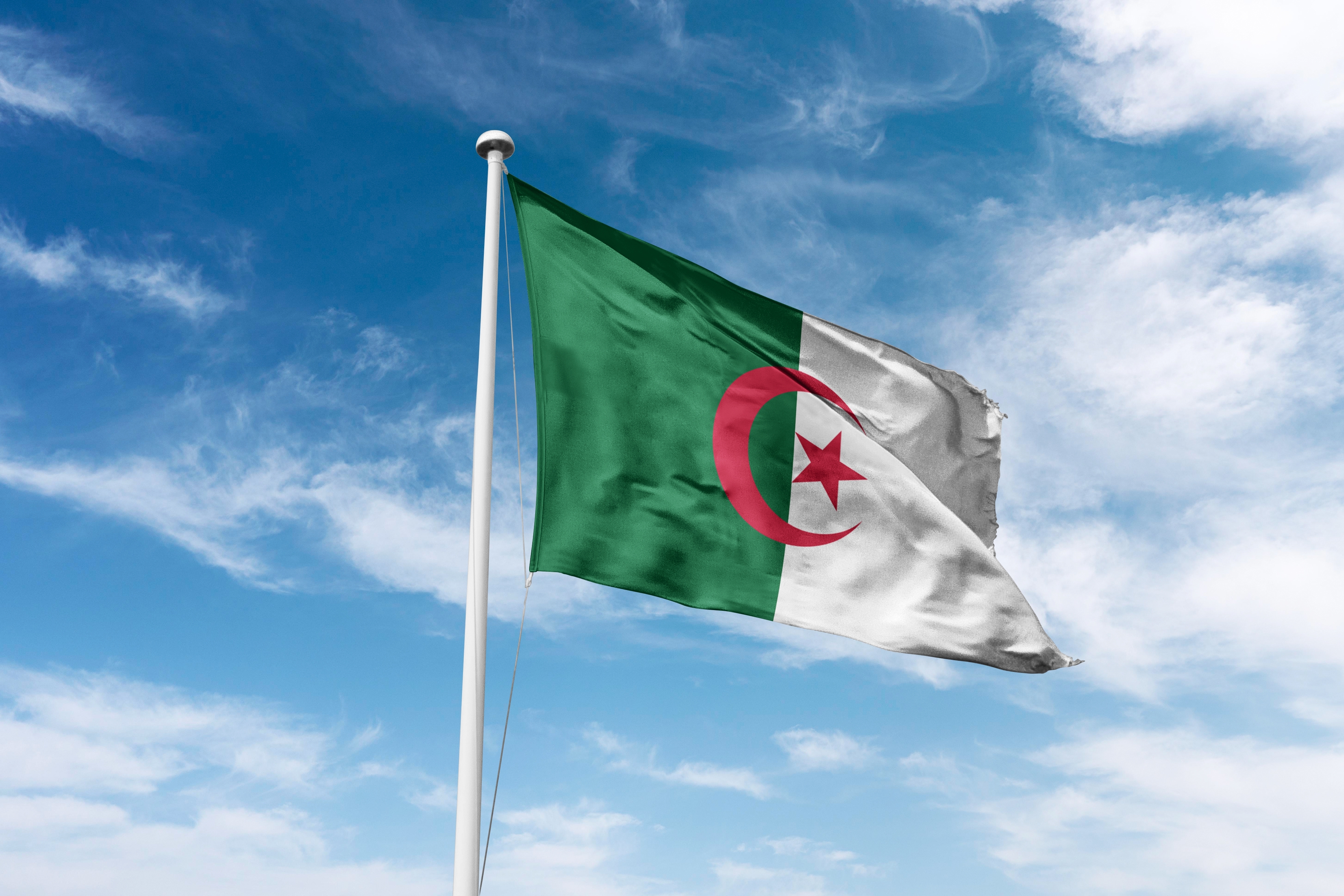
The Algerian flag flying against a cloudy sky, © licensed under Shutterstock.
1. Introduction
Algeria's counter-terrorism legal framework has become a primary instrument in the government’s systematic campaign to silence dissent. At its core is article 87 bis of the Penal Code, a vague and sweeping provision that defines terrorism-related acts so broadly that peaceful protest, journalism, trade union activity, and human rights work can all fall within its scope. Introduced into the Penal Code in 1995 and progressively expanded through successive rounds of amendments in 2014, 2016, 2021, and 2024, article 87 bis has become the authorities’ instrument of choice for criminalising dissent.
Algeria’s counter-terrorism framework has garnered consistent international criticism for its chilling effect on human rights and fundamental freedoms, in law and in practice. UN human rights experts have repeatedly raised alarms about article 87 bis’ incompatibility with international human rights standards, warning that its vague and overbroad definition of terrorism allows authorities to criminalise the peaceful exercise of fundamental rights. Despite growing international pressure, Algerian authorities have not only failed to reform article 87 bis but have instead expanded its scope through successive legislative amendments.
MENA Rights Group has documented the arbitrary arrest, detention, and prosecution of human rights defenders, journalists, lawyers, and peaceful activists under article 87 bis and related provisions. This pattern particularly intensified following the emergence of the Hirak protest movement in 2019. According to human rights defender and former prisoner of conscience Zaki Hannache, over 1,400 people have been imprisoned for politically-related motives since the Hirak, many of whom on terrorism or security-related charges.
2. Legal framework
Algeria's counter-terrorism legal framework is primarily contained in article 87 bis of the Penal Code and a series of related provisions introduced and expanded over three decades. First inserted into the Penal Code in 1995, article 87 bis defines "terrorist or sabotage" acts by reference to broad and imprecise concepts such as "state security", "national unity", and the "stability and normal functioning of institutions", leaving wide discretion to authorities in determining what conduct falls within its scope. Since 1995, the framework has been significantly expanded through four successive rounds of legislative amendments in 2014, 2016, 2021, and 2024, each broadening either the definition of terrorism, the range of associated offences, or both. As UN human rights experts have repeatedly warned, this accumulation of vague and overbroad provisions creates a framework that is fundamentally incompatible with international human rights standards and that lends itself to abuse against those who peacefully exercise their fundamental rights.
2.1 Article 87 bis: Origins and incorporation into the Penal Code in 1995
Algeria’s counter-terrorism framework is primarily contained within article 87 bis of the Penal Code. Although the Penal Code itself dates to 1966, article 87 bis was not part of its original text. It was introduced in 1995 through Ordinance n° 95-11 of 25 February 1995, which inserted a new section into the Penal Code titled "crimes qualified as terrorist or sabotage acts", simultaneously abrogating a standalone counter-terrorism decree that had been in force since 1992.
In its original form, article 87 bis defined a “terrorist or sabotage” act as any act targeting “the safety of the State, the integrity of the territory, the stability and the normal functioning of institutions”, committed with the intent to “spread terror among the population and create a climate of insecurity, by morally or physically harming persons, or by endangering their life, their liberty, or their security, or by damaging their property”, “obstruct traffic or freedom of movement on roads, and occupy public spaces through gatherings”, “attack the symbols of the Nation and the Republic, and desecrate graves”, “damage means of communication and transport, public and private property, seize or occupy them unlawfully”, “harm the environment or introduce into the atmosphere, soil, subsoil, or waters, including territorial seas, any substance liable to endanger human or animal health, or the natural environment”, “obstruct the action of public authorities, or the free exercise of worship and public freedoms, as well as the functioning of institutions contributing to public service” or “obstruct the functioning of public institutions, or harm the life or property of their agents, or hinder the enforcement of laws and regulations”.
Moreover, all of the above offences have, from the outset, been subject to the exceptional penalty scheme set out in article 87 bis 1: “the death penalty applies where the law otherwise provides for life imprisonment; life imprisonment where the law otherwise provides for imprisonment of 10 to 20 years; imprisonment of 10 to 20 years where the law otherwise provides for imprisonment of five to 10 years; and all other penalties are doubled. Article 87 bis 2 extends this logic further, stipulating that for all acts not falling under any of the categories provided for in article 87 bis, the penalty shall be doubled compared to that provided for in the Penal Code or other specific legislation, where those same acts are linked to terrorism and subversion”.
The Penal Code further criminalises a wide range of conduct linked to terrorist organisations. Article 87 bis 3 provides that "anyone who creates, founds, organises, or directs any association, body, group, or organisation whose purpose or activities fall under the provisions of Article 87 bis shall be punished with life imprisonment. Any membership or participation, in any form, in the associations, bodies, groups, or organizations referred to above, with knowledge of their purpose or activities”, is punishable by imprisonment of 10 to 20 years.
Beyond organisational involvement, the framework also targets those who support or promote terrorist acts. Article 87 bis 4 sets out that anyone who “makes the apology for, encourages, or finances, by any means whatsoever” acts classified as terrorist or sabotage acts under article 87 bis is punishable by imprisonment of five to 10 years and a fine of 100,000 to 500,000 Algerian dinars.
Article 87 bis 5 further provides that “anyone who knowingly reproduces or disseminates documents, printed matter, or recordings making the apology” of acts classified as terrorist or sabotage under article 87 bis is punishable by imprisonment of five to 10 years and a fine of 100,000 to 500,000 Algerian dinars.
The reach of the framework also extends beyond Algeria’s border. Article 87 bis 6 provides that “any Algerian who is active or enrols abroad in an association, group, or terrorist or subversive organisation, regardless of their form or denomination, even if their activities are not directed against Algeria” is punishable by imprisonment of 10 to 20 years and a fine of 500,000 to 1,000,000 Algerian dinars. Where such acts are intended to “harm the interests of Algeria”, the penalty shall be life imprisonment.
2.2 2014 amendments: Expanding the scope of terrorist or sabotage acts
In 2014, Algeria expanded the definition of article 87 bis to include additional acts relating to transport, navigation, destruction of means of communication, hostage-taking, attacks using explosives, as well as the “financing of a terrorist or a terrorist organisation”.
2.3 2016 amendments: Criminalising online activity and foreign travel
In 2016, Algeria extended its counter-terrorism framework to cover foreign travel and the use of information and communication technologies, introducing two new articles into the Penal Code.
Article 87 bis 11 criminalises travel or attempted travel by Algerian nationals or foreign residents to another country for the purpose of committing, organising, preparing, or participating in terrorist acts, or of giving or receiving training to commit such acts, punishable by imprisonment of five to 10 years and a fine of 100,000 to 500,000 Algerian dinars. The same penalties apply to anyone who deliberately finances or organises such travel, or who uses information and communication technologies to commit any of the acts described in this article. Article 87 bis 12 criminalises the use of information and communication technologies to recruit individuals on behalf of a terrorist individual or of an association, body, group, or organisation whose purpose or activities fall under the counter-terrorism provisions of the Penal Code, or to support its acts or activities or disseminate its ideas, whether directly or indirectly, punishable by imprisonment of five to 10 years and a fine of 100,000 to 500,000 Algerian dinars.
2.4 2021 amendments: Post-Hirak expansions and the national terrorist list
In the wake of the Hirak protest movement, a 2021 presidential ordinance significantly expanded the counter-terrorism framework, both broadening the definition of terrorist or sabotage acts under article 87 bis and establishing a national list of terrorist persons and entities.
The ordinance modified the opening formula of article 87 bis, replacing “the integrity of the territory” with “national unity” as one of the protected interests against which terrorist or sabotage acts are defined. It also broadened the definition further by adding two new acts: “working or inciting, by any means whatsoever, to gain power or change the system of governance by unconstitutional means” and “undermining the integrity of the national territory, or inciting others to do so, by any means whatsoever”.
The same ordinance introduced articles 87 bis 13 and 87 bis 14 to the Penal Code, establishing a national list of terrorist persons and entities. Article 87 bis 13 provides that a national list of terrorist persons and entities is established for those who commit any of the acts referred to in article 87 bis, classified as “terrorist person” or “terrorist entity” by a classification commission. The provision specifies that no person or entity may be included on the list unless they are the subject of a preliminary investigation or criminal prosecution, or their guilt has been declared by a judgment or ruling. The decision to include on the national list is published in the Official Gazette, which constitutes notification to those concerned, who have the right to request their removal from the national list within 30 days of publication.
Article 87 bis 14 provides that inclusion on the national list entails the prohibition of the activity of the person or entity concerned, and the seizure and/or freezing of their funds and of funds deriving from property belonging to it or controlled by them, directly or indirectly, or by persons acting on their behalf or under their instructions. Inclusion on the list also entails a travel ban, imposed by judicial decision at the request of the commission.
2.5 2024 amendments: New offences and extended non-parole periods
In 2024, a further set of amendments to the Penal Code expanded Algeria’s counter-terrorism framework on several fronts.
The 2024 amendments revised and expanded the national terrorist list mechanism under article 87 bis 13, extending its scope beyond acts falling under article 87 bis to include acts falling under Law No. 05-01 of 2005 on the prevention and fight against money laundering and the financing of terrorism, as well as “acts of participation in the financing or organisation, facilitation, preparation, or execution of terrorist crimes or their support of any kind”.
Four new articles were additionally introduced. Article 87 bis 15 criminalises the financing of the proliferation of weapons of mass destruction. Article 87 bis 16 provides that attempting to commit any offence under this section is punishable by the same penalties as the completed offence. Article 87 bis 17 provides for the mandatory confiscation of any funds or proceeds resulting from terrorism-related offences under article 87 bis, even where the criminal prosecution has been extinguished. Article 87 bis 18 criminalises providing financial or economic resources to persons on the national terrorist list, punishable by imprisonment of one to three years and a fine of 100,000 to 300,000 Algerian dinars.
The 2024 amendments also modified article 96 of the Penal Code, which criminalises the distribution of content likely to “harm the national interest”, to explicitly extend its reach to acts committed through information and communication technologies.
Article 87 bis 9 was also revised to make the non-parole period (“période de sûreté”) provided for under article 60 bis applicable to all offences under the counter-terrorism section of the Penal Code. This mechanism prohibits convicted persons from benefiting from any sentence reduction or early release measure including sentence suspension, work release, day release, semi-liberty, or conditional liberation, for a duration equal to half the sentence pronounced, or 20 years in the case of a life sentence.
3. Two decades of international criticism
Algeria’s counter-terrorism framework has attracted sustained and growing international criticism for nearly two decades. Since 2008, multiple UN human rights bodies have raised concerns about its compatibility with international human rights law, including the UN Committee against Torture, the UN Human Rights Committee, the Special Rapporteur on human rights and counter-terrorism, the Special Rapporteur on freedom of peaceful assembly and of association, the Special Rapporteur on the situation of human rights defenders, the UN Working Group on Arbitrary Detention, the Special Rapporteur on freedom of expression, the Special Rapporteur on the independence of judges and lawyers, and more.
3.1 The vague and overbroad definition of terrorism under article 87 bis
International concern about article 87 bis dates back to 2008, when the UN Committee against Torture raised alarm about the provision’s vague definition and warned it could “extend to acts which may be unrelated to terrorism”, adding that the definition of terrorist acts should not give rise to interpretations whereby the legitimate exercise of rights established under the International Covenant on Civil and Political Rights (ICCPR) can be sanctioned as terrorism.
In 2018, the UN Human Rights Committee reiterated these concerns, observing that article 87 bis “defines the crime of terrorism in overly broad and vague terms that would allow for the prosecution of actions that might constitute exercise of the freedom of expression or peaceful assembly”, and expressing concern about the “inappropriate use of counter-terrorism measures against human rights defenders and journalists”. The Committee called on Algeria to “amend article 87 bis of the Penal Code so that it clearly defines what constitutes an act of terrorism”.
Rather than addressing these concerns, Algerian authorities expanded the scope of article 87 bis further through the 2021 amendments. UN Special Procedures responded with a detailed communication specifically addressing the revised definition, stressing that it does not comply with international standards. The UN experts noted that even as amended, article 87 bis “fails to meet each of the three cumulative elements proposed by the Special Rapporteur on human rights and counter-terrorism to properly define terrorism”: the use of lethal means is not required; the intent to instil fear is only optional, listed as one of several possible aims; and the ideological element is not clearly stated.
The experts raised particular concern about one specific addition made by the 2021 amendments: the criminalisation of “working or inciting, by any means whatsoever, to gain power or change the system of governance by unconstitutional means”. They cautioned that such wording could “negatively impact freedoms of expression, association and peaceful assembly”, as it might be applied “against peaceful activists and demonstrators seeking to advance their movements and demands through channels other than those provided by the institutional framework established by the authorities”.
In 2023, two UN Special Rapporteurs conducted official visits to Algeria and issued reports raising serious concerns about the country’s counter-terrorism framework. The former Special Rapporteur on freedom of peaceful assembly and of association stated that “in almost every conversation [he] had with civil society representatives, concerns were raised about article 87 bis”. The Special Rapporteur stated that the provision is “inconsistent with the principle of legal certainty”, and that “the large number of civil society actors facing terrorism-related charges under article 87 bis of the [Penal] Code is evidence of the current climate of suspicion towards civil society actors”. He ultimately recommended that Algeria repeal article 87 bis. The Special Rapporteur on human rights defenders similarly observed that “the definition of terrorism in article 87 bis is so broad and vague that it makes it possible for human rights defenders to be arrested on a large scale”. She urged Algeria to amend and align it with international standards, “according to which the definition of terrorism and related crimes must be accessible, formulated with precision, non-discriminatory and non-retroactive”.
Most recently, in December 2025, eight Special Procedures mandate holders addressed a new communication to Algerian authorities, presenting the most detailed assessment yet of article 87 bis’ incompatibility with international law. Addressing both the 2021 and 2024 amendments, the experts expressed concern that these changes “appear to have further broadened the definition of terrorism”, warning that this expansion creates “a risk of criminalising the legitimate exercise of fundamental rights, which would be contrary to Algeria’s international obligations”.
They cautioned that certain elements of the offences contained in article 87 bis “are vague and overly broad, and do not meet the requirement of legal certainty” set out in article 15 of the ICCPR, to which Algeria has been a party since 1989. They further underscored the risk that the provision could be “misused to repress freedom of expression, peaceful assembly and association, criticism of or opposition to the government, participation in cultural life, and legitimate human rights defence and advocacy activities”. They concluded by stating that the imprecision of the provisions of article 87 bis “renders them incompatible with the principle of legality enshrined in human rights and international law, and opens the door to excessive and arbitrary criminalisation, which in some cases may amount to judicial harassment”.
3.2 Apology, dissemination, and harm to the national interest: the overreach of related provisions
Beyond the core definition of terrorism, the December 2025 communication raised particular concern about a number of related provisions. Articles 87 bis 4 and 87 bis 5 both carry penalties of five to 10 years’ imprisonment: the former for “anyone who makes apology for, encourages or finances” terrorist or sabotage acts “by any means whatsoever”; the latter for “anyone who knowingly reproduces or disseminates documents, printed matter or information” deemed as “apology” for such acts. The experts raised concern about the "broad, imprecise and unpredictable scope" of the concepts of "apology" and "encouraging" terrorism in both provisions, and noted in particular that article 87 bis 5 "does not provide for exclusions for sharing information for legitimate purposes, such as media reporting, public information, education or research", and "risks being used to repress legitimate activities or expressions and to discourage public debate". They equally raised concern about article 87 bis 12, which criminalises the use of information and communication technologies to support or disseminate the ideas of a "terrorist organisation", noting that it contains vague and imprecise elements and provides no exclusions for legitimate purposes such as media reporting, education or research.
Concerns have also been raised about provisions beyond article 87 bis itself. Both the Special Rapporteur on freedom of peaceful assembly and of association and the Special Rapporteur on the situation of human rights defenders, following their visits to Algeria in 2023, raised concerns about article 96 of the Penal Code, which criminalises the distribution of content likely to "harm the national interest". The Special Rapporteur on freedom of peaceful assembly and of association specifically identified it among a series of broadly worded provisions used to restrict fundamental rights, recommending that it be amended to ensure it cannot be used to deny the rights to freedom of peaceful assembly, association, opinion and expression, whether offline or online. These concerns had previously been raised by the UN Human Rights Committee in 2018, which noted that article 96 criminalised activities linked to the exercise of freedom of expression and was being used to impede the work of journalists and human rights defenders.
3.3 The national list of terrorist persons
Regarding the national list of terrorist persons and entities, introduced by the 2021 amendments, UN Special Procedures warned that it would allow persons or entities to be publicly designated as “terrorist” without the conclusion of a judicial trial, contrary to the presumption of innocence, as it is an administrative measure which does not require a judicial oversight.
3.4 The severity of penalties
UN human rights experts have also drawn attention to the exceptional severity of the penalties underpinning the framework. The December 2025 communication specifically challenged the death penalty applicable for terrorist offences under article 87 bis 1, which is broadly worded and encompasses acts of sabotage aimed at the security of the State, the integrity of the territory or the stability and normal functioning of institutions. The experts emphasised that such an offence fails to meet the requirement of legality and encompasses acts that cannot be considered "the most serious crimes" within the meaning of article 6 of the ICCPR.
3.5 Algeria’s role in the UN counter-terrorism architecture
Paradoxically, despite this sustained and growing international criticism, Algeria has played an influential role in the UN counter-terrorism architecture, including chairing the UN Security Council's Counter-Terrorism Committee (CTC) in 2024–2025 and sitting on the board of the UN Counter-Terrorism Centre (UNCCT). This prominence within the global counter-terrorism system grants Algeria a platform to shape international counter-terrorism norms and standards while it systematically violates the very human rights principles those standards state to protect. Rather than being held accountable for its abuses, Algeria has been positioned to define what legitimate counter-terrorism looks like at the international level, a contradiction that not only undermines the credibility of the global counter-terrorism architecture, but also risks legitimising the use of overbroad counter-terrorism legislation as an instrument of repression.
4. Silencing dissent: Individual cases of repression under article 87 bis
Since the 2019 Hirak protest movement, Algerian authorities have increasingly relied on article 87 bis to crack down on journalists, human rights defenders, trade unionists, and other peaceful critics. According to notable human rights defender and former prisoner of conscience Zaki Hannache the authorities imprisoned over 1,400 people for politically-related motives since the Hirak, many of whom were accused or sentenced on terrorism or security-related charges.
In 2021, Algerian authorities designated the political opposition movement Rachad and the Movement for the Self-Determination of Kabylie (MAK) as “terrorist organisations”. This designation was made by the High Security Council (HCS), a consultative body chaired by the President of Algeria, without judicial oversight. The HCS subsequently oversaw the arrest and prosecution of several alleged members of the MAK and Rachad on the basis of their affiliation with what had previously operated as peaceful organisations. In September 2021, authorities arrested 15 Amazigh activists, along with journalist Mohamed Mouloudj, and charged them with terrorism-related offences for their alleged links to the MAK.
Similarly, members of the dissolved Algerian League for the Defence of Human Rights (LADDH) were prosecuted on terrorism charges following their arrest in April 2021. Those targeted included human rights defender Kaddour Chouicha, journalists Jamila Loukil and Saïd Boudour, as well as 13 other peaceful activists. After several years of proceedings, they were acquitted in December 2023, and the acquittal was upheld on appeal in February 2025. The prosecutor, however, subsequently lodged an appeal before the Supreme Court. UN Special Procedures issued communications concerning their cases in April 2021 and June 2023.
Later in 2021, Algerian authorities sentenced human rights defender Mohad Gasmi to six years’ imprisonment for “apology for terrorism”. He was released after four years in prison pursuant to a presidential pardon. Gasmi, an environmental and social rights defender from southern Algeria, was part of the Unemployed Movement, the anti-shale gas drilling movement, and an active participant in the Hirak.
In 2022, Zaki Hannache was arrested and charged with “apology for terrorism”. Following his conditional release, he sought asylum with the United Nations High Commissioner for Refugees (UNHCR) in Tunisia due to the serious threats he faced in Algeria in connection with his legitimate human rights work. Hannache is an Amazigh human rights defender who since 2019 has documented the arrests and prosecutions of prisoners of conscience, becoming one of the main sources of information on arbitrary detentions in Algeria for local and international civil society, as well as UN human rights mechanisms.
In 2023, human rights defender Ahmed Manseri was charged with “belonging to a terrorist organisation”. Manseri, head of the Tiaret section of the now-dissolved LADDH, was arrested just weeks after meeting with the UN Special Rapporteur on freedom of peaceful assembly and association, and a photograph of that meeting was reportedly included in his case file.
In 2024, lawyer Sofiane Ouali was charged with “crime of making the apology for and incitement to terrorist acts” and “using the media and communication technologies to support the actions and activities of terrorist organisations and to disseminate their ideas in a direct or indirect manner” and is awaiting trial at the time of writing. Ouali had represented several prisoners of conscience and faces charges stemming from a sit-in he organised in July 2024 in solidarity with one of his clients, the Amazigh activist Mira Moknache. UN Special Procedures addressed a communication to the Algerian authorities regarding his case, expressing concern over the recurring use of article 87 bis against activists and underscoring that this provision “undermines the principle of legal certainty, the rights of peaceful assembly and freedom of expression, and imposes disproportionate penalties for acts that should not be dealt with under anti-terrorism legislation”.
Mohamed Tadjadit, a poet and human rights defender known for his prominent role in the Hirak movement, has been arrested at least eight times since 2019, amounting to sustained judicial harassment in response to his peaceful criticism of the Algerian government. In October 2022, the UN Working Group on Arbitrary Detention (WGAD) issued Opinion No. 45/2022 concerning his 2021 arrest and detention following his publication on social media of a minor’s testimony alleging sexual abuse in police custody, concluding that his detention was arbitrary and constituted a violation of his right to freedom of opinion and expression.
In January 2024, Tadjadit was arrested once again and charged under article 87 bis with “apology for terrorism” and “crime of using the media and communication technologies to support the actions and activities of terrorist organisations and to disseminate their ideas in a direct or indirect manner.” The charges were based on private conversations he had held on Messenger in 2021 with members of Rachad, before the classification of the organisation as a terrorist organisation, as well as on social media posts criticising the authorities and expressing support for the Hirak movement. In January 2026, he was sentenced on appeal to three years’ imprisonment on these terrorism-related charges.
He is also facing a separate case on charges of “attacks, conspiracies and other offences against the authority of the State and the integrity of the national unity” under article 77 of the Penal Code, which carries the possibility of the death penalty. His trial in that case is scheduled for the next criminal session of 2026. Tadjadit had already been tried and sentenced to a prison term in 2021 in relation to the same social media posts, detention which the WGAD had found to be arbitrary.
Another recent case concerns Ali Mammeri, president of the National Union of Cultural Workers and member of the Confederation of Trade Unions of Productive Forces (COSYFOP). He was arrested in March 2025, just four days after being elected union president. Mammeri was charged under article 87 bis, including for “apology for terrorism”, on the basis of communications with COSYFOP leadership, which the authorities have labelled a “subversive organisation”, as well as peaceful social media activity characterised by the authorities as constituting apology for terrorism. He was sentenced to 15 years in prison in October 2025, which was reduced to 10 years in prison on appeal in February 2026.
UN Special Procedures have expressed alarm over the terrorism-related convictions of Tadjadit and Mammeri, voicing concern over the imposition of terrorism-related sentences against two peaceful human rights defenders. They stated that the prosecutions “seem to be linked to the exercise of their rights to freedom of opinion, expression, including artistic expression, freedom of peaceful assembly and participation in public life, as guaranteed by articles 17, 19, 21, and 25 of the ICCPR”. They further indicated that these measures could “also constitute violations of articles 2 (non-discrimination), 7 (prohibition of torture and ill-treatment), 9 (liberty and security), 14 (right to a fair trial), 16 (recognition of legal personality), 17 (privacy) and 26 (equality before the law)” of the ICCPR.
The aforementioned cases expose a systematic and deliberate pattern of repression: the instrumentalization of vague counter-terrorism legislation to criminalise the legitimate exercise of fundamental freedoms, leading to prolonged arbitrary detention, unfair trials, disproportionately harsh sentences, and the progressive dismantling of civic space.
5. Conclusion
Nearly two decades of consistent international criticism demonstrate that Algeria's counter-terrorism framework is fundamentally incompatible with international human rights law and is being systematically weaponised to suppress civic space. The cases documented in this report illustrate a deliberate pattern of using vague and overbroad laws to criminalise the legitimate exercise of fundamental freedoms. Over 200 prisoners of conscience are currently behind bars in Algeria, according to human rights defender Zaki Hannache, many of whom were prosecuted or sentenced under counter-terrorism provisions. Many others have been forced into exile, silenced through intimidation, or subjected to ongoing judicial harassment.
This framework urgently requires comprehensive reform. At a minimum, the definition of terrorism under article 87 bis must be narrowed and brought into full conformity with international standards, including the principles of legality, necessity, and proportionality. Ultimately, and in line with the recommendation of the UN Special Rapporteur on freedom of peaceful assembly and of association, this framework should be repealed altogether. Moreover, the national terrorist list mechanism must be subject to independent and effective judicial oversight. Finally, all prisoners of conscience held solely for the exercise of their fundamental rights should be immediately and unconditionally released, and all related charges must be dropped.
Until these reforms are implemented, Algeria's counter-terrorism framework will continue to serve as a tool of political control, undermining the rule of law and eroding the space for the peaceful exercise of fundamental rights.