May 03, 2026
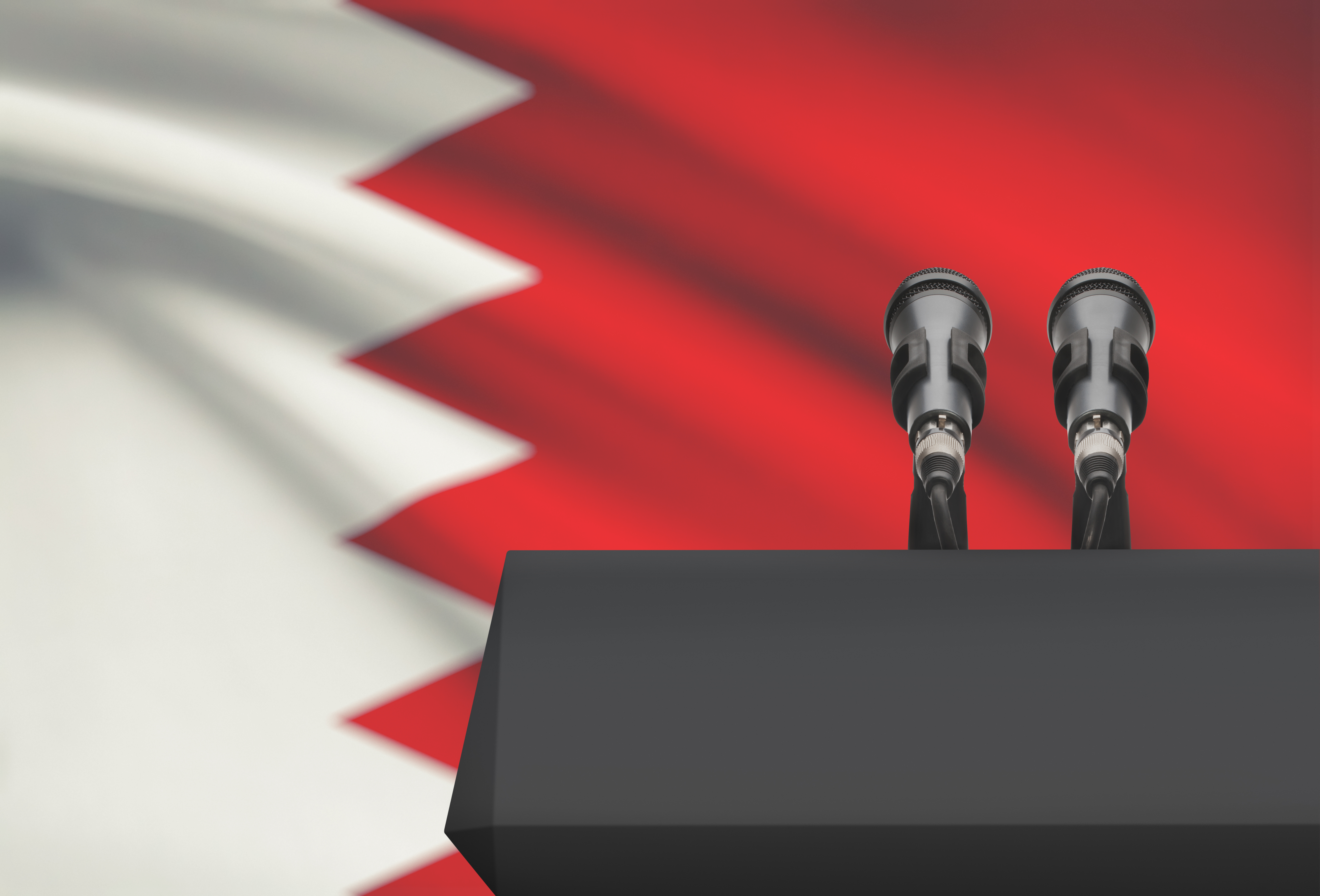
Pulpit and two microphones with a flag on background - Bahrain © Niyazz, licensed under Shutterstock.
On World Press Freedom Day 2026, the government of Bahrain continues to criminalise dissent through laws that violate Bahrain’s international human rights obligations, through heavy restrictions on media ownership and the arbitrary arrest of those who peacefully express their views online or in peaceful gatherings. This suppression has strangled Bahrain’s media and online expression and severely restricted people’s rights to peaceful assembly and association. The government must urgently amend media ownership laws and those relating to expression in order to abide by its own human rights commitments.
In contrast to the values of World Press Freedom Day, the Bahraini authorities’ actions demonstrate that they reject the vital role of a free, independent, and pluralistic media in building lasting peace and security. The government owns all national broadcast media outlets and individuals with close ties to the government run the main privately-owned newspapers: no independent media outlets are able to operate in Bahrain. Furthermore, in 2017, the Bahraini authorities closed down the country’s only non-state owned newspaper, Al-Wasat.
Repressive legislation criminalises peaceful expression in Bahrain. On October 30, 2025, the King issued the Press and Electronic Media Law No. (41) of 2025. This law represents a serious regression from Bahrain’s constitutional and international obligations regarding freedom of opinion, expression, and press freedoms. It expands prior censorship and punitive administrative measures to include digital media, while leaving the door open for criminal prosecution through other legislation, most notably the Penal Code and the Counter-Terrorism Law. The law is a setback due to its blatant contradiction of Article 19 of the International Covenant on Civil and Political Rights, to which Bahrain is a state party, which stipulates that restrictions on freedom of opinion, expression, and the press must be strictly limited, necessary, and proportionate to a legitimate aim. A thorough reading of the proposed texts and a comparison with existing legislation reveals that these amendments offer no real breakthrough in the area of freedoms. On the contrary, they strengthen the state’s tools for controlling the media and electronic spaces, and keep journalists and media institutions under constant threat of prosecution and administrative closure.
Despite the removal of the direct imprisonment penalty from the articles of the new Press Law, the law maintains the general reference to “any stricter penalty in other laws,” which allows journalists and internet activists to be tried under the Penal Code or other laws, which opens the door to harsher prison sentences. Therefore, “abolishing imprisonment” becomes merely a trick directed at the international community to beautify Bahrain’s human rights image, while the reality remains the same: journalists are vulnerable to imprisonment under the cover of other laws.
The Bahraini authorities restrict access to media by blocking websites and they remove a variety of content published online, especially social media posts criticising the government. Foreign journalists rarely have access to Bahrain and face difficulties obtaining entry visas to the country, and their speech is limited when they do have access.
Reporters Without Borders (RSF) ranked Bahrain 157th out of 180 in its 2025 World Press Freedom Index. In 2025, Freedom House ranked Bahrain’s ‘global freedom’ at 12/100, its ‘internet freedom’ at 30/100 and classified Bahrain as ‘not free’.
Bahrain’s repressive media environment exacerbates social and sectarian divisions in a context of conflict
Between late February and April 2026, the US and Israel carried out thousands of attacks across Iran. Iran’s response has impacted, amongst other countries, Bahrain. The state-owned Bahrain News Agency reported that, as of 19 March 2026, at least two people had been killed in the country and at least 46 had been injured. Pre-existing media restrictions which require, broadly, the media to echo government positions, meant that Bahrainis could not express their various assessments and sentiments in respect to the regional conflict and its impact on them: restrictions that serve to augment social tension, rather than provide a release and space for public discourse.
On 1 March 2026, hours after Iranian state media confirmed the death of the country’s Supreme Leader, Ayatollah Ali Khamenei, large crowds of Bahraini Shi’a took to the streets in peaceful demonstrations mourning his death and protesting US and Israeli attacks on Iran.
On 5 March, Bahrain’s Interior Ministry’s Civil Defense Council declared it was banning protests “in order to preserve public safety and enhance civil protection measures.”
On 9 March 2026, the Public Prosecutors’ office called for the imposition of the death penalty for some of those detained,”due to their involvement in espionage.”
Human rights organizations have documented hundreds of arrests since the start of the conflict. The justifications offered by the Bahraini authorities for these arrests included: sharing images showing damage caused by attacks within Bahrain; sending videos depicting this damage to external parties; and filming missile and drone strikes and posting the footage online. Others were arrested for participating in demonstrations or expressing political opinions related to the events unfolding in the region.
One such example of the sweeping arrests carried out by the Bahraini authorities was reported on 3 April 2026 by Associated Press, revealing that on 1 March, “21-year-old Hussein Fatiil and a friend posted social media videos of themselves waving a poster of Iran’s supreme leader at a protest outside the U.S. Embassy” and that “minutes later, plainclothes officers took them away in an unmarked car.” The men made one phone call home, but only three days later did Hussein Fatiil inform his family in a phone call that the authorities charged him with five offenses, including “misusing social media and inciting hatred and treason.”
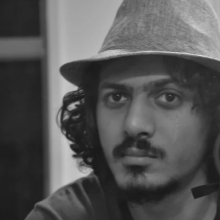
On 7 April 2026, Bahrain’s General Directorate of Criminal Investigation and Forensic Science summoned prominent environmental activist and artist Mohammed Jawad Hameed, who remains in detention after an initial 15-day period was extended.
On 23 April 2026, a local NGO provided an updated snapshot of the arrests relating to the conflict (from 1 March to 21 April, 2026), comprising:
- 309 people detained since the beginning of the war, including four women and eight non-Bahrainis;
- 25 people released following arrest, including six women, one of whom was married to a Bahraini, and whom the government deported; and
- 284 people currently detained;
- 24 people under the age of 18 detained, of whom the government transferred 17 to the Dry Dock Detention Centre [for minors];
- 1 death in custody (Sayed Mohammed Al-Mousawi).
The undersigned organisations are seeking confirmation of identities of those detained, any charges made and evidence that the administration of justice abides by international human rights standards.
We urge the government of Bahrain to act immediately to reduce communal and sectarian tension in Bahrain by taking concrete action on longstanding, specific recommendations made by successive UN treaty bodies and international partners like the EU and UK, including in the context of the Universal Periodic Review, to
- End the effective strangulation of the media environment, digital and other written and oral expression, by repealing and amending ownership regulations and laws that criminalise critical expression;
- Repeal and amend the 2018 political isolation laws, including those that restrict civic space; and
- Ensure that the government adheres to the international human rights standards to which it is legally bound.
We call on Bahrain’s international partners to urge their Bahraini counterparts authorities to:
- Ensure that fair procedures in the administration of justice be adhered to in the conduct of the arrests Bahraini authorities are currently carrying out;
- Repeal and amend ownership regulations for media platforms;
- Repeal and amend provisions that criminalise the peaceful expression of conscientiously held beliefs; and
- Take concrete measures to ensure media freedom is implemented in Bahrain and hold the authorities to account in relation to the conduct of an election that abides by Article 25 of the ICCPR.
Further information
The 2011 human rights crisis continues to shape current government conduct in relation to the criminalisation of expression: members of Bahrain’s political opposition, human rights defenders, and journalists remain behind bars for their involvement in the 2011 pro-democracy protests and their ongoing activism, having been deliberately excluded from royal pardons granted by the authorities.
One especially pertinent example is that of Dr. Abduljalil al-Singace, a 64-year-old Bahraini writer, engineer, academic and award-winning human rights defender whom the authorities detained in March 2011 for his role in peaceful pro-democracy protests. Since July 2021, he has been on a prolonged hunger strike in protest of the confiscation of his written academic work, surviving on minimal health supplements and, more recently, reportedly refusing even saline intake. Another prominent human rights defender, Abdulhadi Al-Khawaja, also remains in prison serving a life sentence for his role in the 2011 protest movement. Al-Khawaja has repeatedly been penalised for speaking out about poor prison conditions, and carrying out human rights protests in prison. These cases are emblematic of Bahrain’s broader repression of those exercising their right to freedom of expression.
Signed
ALQST for Human Rights
Bahrain Forum for Human Rights
Bahrain Press Association
DAWN
FairSquare
Gulf Centre for Human Rights (GCHR)
Gulf Institute for Democracy and Human Rights
Human Rights Watch
MENA Rights Group
Salam for Democracy and Human Rights